
Universities Unite for Science-Based Ocean Action in Lesser Sunda Seascape
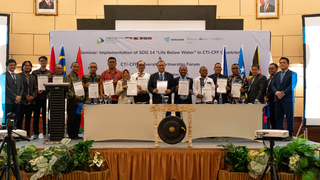
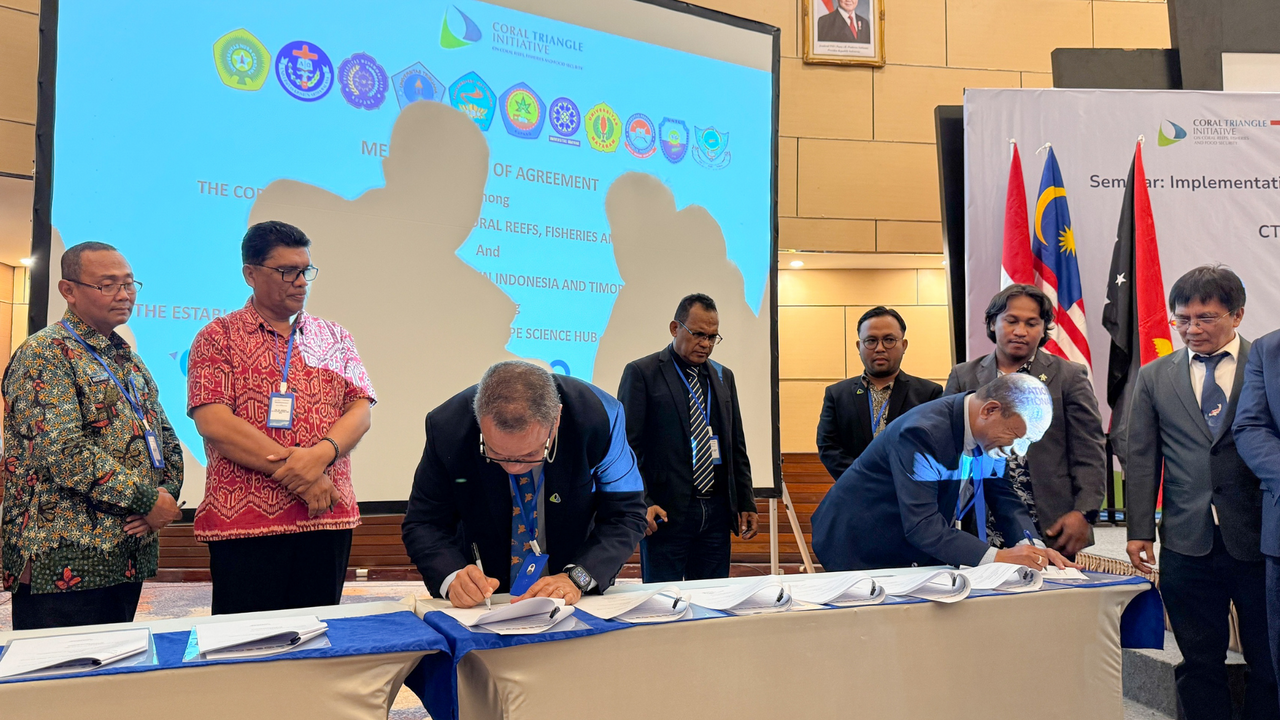
Universities from the Lesser Sunda Seascape have formalised a new research partnership with the support of an IKI project to strengthen science-based marine conservation.
Twelve universities from Indonesia and Timor-Leste signed a Memorandum of Agreement (MoA) in October 2025 in Bali to establish the Lesser Sunda Seascape Science Hub – University Partnership under the Coral Triangle Initiative on Coral Reefs, Fisheries and Food Security (CTI-CFF). The agreement marks an important milestone in strengthening cross-border, science-based marine conservation in one of the world’s most biodiverse regions. This initiative is part of the implementation of the IKI-supported Solutions for Marine and Coastal Resilience in the Coral Triangle (SOMACORE) Programme, which is being implemented by ten organizations across the Coral Triangle.
Protecting marine biodiversity and coastal livelihoods
The Lesser Sunda Seascape, which covers the waters of Bali, West Nusa Tenggara, East Tenggara Province in Indonesia and Timor Leste, and parts of the Southwest Maluku, is a vital component of the Coral Triangle and supports both exceptional marine biodiversity and millions of coastal livelihoods. However, the region faces increasing pressures from climate change and human activities. The newly established Science Hub aims to address these challenges by improving regional cooperation on research, knowledge exchange, and policy-relevant science.
Building on a university partnership launched in 2017, the Science Hub reinforces the role of universities as key drivers of science-based action for resilient oceans and sustainable coastal development. Additionally, this provides a collaborative platform for universities, government agencies, and development partners to jointly advance marine and fisheries research, strengthen academic capacity, and produce scientific outputs that support sustainable ocean governance.
Dr. Frank Keith Griffin, Executive Director of the CTI-CFF Regional Secretariat, described the initiative as a strategic mechanism for linking science with policy and practice and noted its role in supporting collaborative research on coral reef conservation, sustainable fisheries management, and the protection of migratory marine species.
Twelve universities join forces
The partnership brings together ten universities from Indonesia (Nusa Cendana University, Artha Wacana Christian University, Muhammadiyah University of Kupang, Tribuana Kalabahi University, Pattimura University, Kupang State Agricultural Polytechnic, Udayana University, Mataram University, Defense University, and Sam Ratulangi University) and two universities from Timor-Leste (Universidade Nacional Timor Lorosa'e and Universidade Oriental Timor-Lorosa'e).
The Science Hub aims to generate science-based policy recommendations that support blue economy development and improve the well-being of coastal communities, while also contributing to the implementation of SDG 14: Life Below Water.
According to Tutus Wijanarko, SOMACORE Project Lead for Konservasi Indonesia, the MoA is accompanied by an agreement to develop a joint work plan for 2026–2030 aligned with the CTI-CFF Regional Plan of Action 2.0 for 2021–2030. He emphasized that the Science Hub will strengthen regional scientific databases, promote multidisciplinary research, and support climate-adaptive, transboundary marine conservation policies. Konservasi Indonesia, through the SOMACORE Programme, will support the Science Hub this year with a series of capacity building-training and research grants.
More highlights from the project in 2025
Another major political milestone for the IKI project was reached at the 20th CTI-CFF Senior Officials Meeting in Bali in December 2025, where senior officials acknowledged the advancement of the IUCN Green List pathway for marine protected areas. This acknowledgment reaffirmed the regional commitment to improving the quality, equity, and effectiveness of marine protected areas beyond area-based targets. The SOMACORE Programme played a key role in this development by proactively supporting a series of events and regional exchanges, translating dialogue into concrete action and strengthening the resilience of marine and coastal ecosystems and communities across the Coral Triangle.


The link has been copied to the clipboard
Contact
IKI Office
Zukunft – Umwelt – Gesellschaft (ZUG) gGmbH
Stresemannstraße 69-71
10963 Berlin