
From bush to biomass
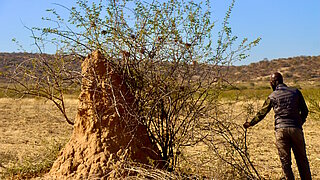
Namibia is turning encroaching bush into biomass for renewable energy, new industries and rural livelihoods.
Looking across the open savannah on Farm Buffelhoek in central Namibia, farmer and landowner Koos Briedenhann points to a landscape that looks markedly different from the one he inherited. Today, grasses sway between scattered trees and livestock graze across open rangeland.
Only a few years ago, much of the land was choked by dense thorn bush. For Koos, restoring the land has transformed his farm. For Namibia, the story is much bigger.
Across millions of hectares, the Namibia – Biomass project is turning this encroaching bush into a resource that powers industries, creates jobs, and restores landscapes.
A country shaped by land and energy
Around 70% of Namibia’s population relies on farming and cattle herding, particularly in rural areas. But as one of sub-Saharan Africa’s driest countries, Namibia faces erratic rainfall, prolonged droughts, and increasing land degradation.
The country also faces rising energy demand while relying heavily on imported, coal-based electricity. Close to half of the population lacks access to electricity. As Namibia seeks to strengthen its energy security and reduce greenhouse gas emissions, renewable energy has become a national priority. Alongside solar and wind, the country has another largely untapped resource: woody biomass.
The national crisis of bush encroachment
More than 45 million hectares of Namibia are affected by bush encroachment. As woody plants spread across grasslands, they reduce the availability of grasses for livestock and wildlife and limit agricultural productivity.
For Koos, the impact was immediate. As thorn bush spread across Farm Buffelhoek, cattle could no longer move freely and grass disappeared beneath dense shrubs.
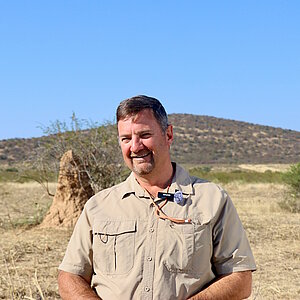
Let us give the soil back to the next generation in a savannah form.
The impacts of bush encroachment also extend beyond agriculture. As bush replaces grass, habitats for many species are degraded, threatening biodiversity and the nature-based tourism on which Namibia’s economy also depends.
From problem to resource
What was once mainly seen as a cost of land management is increasingly becoming an economic resource. Since the early 2000s, harvested bush has been used to produce charcoal for export. New value chains now include wood chips, industrial heat, animal feed and innovative building materials. The industry is growing fast – and the Namibia-Biomass project is part of the growth.
The project is developing sustainable biomass value chains through the construction and operation of the 40 MW Otjikoto Biomass Power Station (OBPS), creating a locally sourced renewable energy option that strengthens energy security and grid stability.
The plant will be the world’s first large-scale biomass power plant fueled primarily by encroaching bush, supplying around 300 gigawatt hours of baseload electricity annually – roughly seven percent of Namibia’s current electricity needs.
Crucially, the plant also creates a market for harvested biomass, linking land management with energy production and rural economic development.
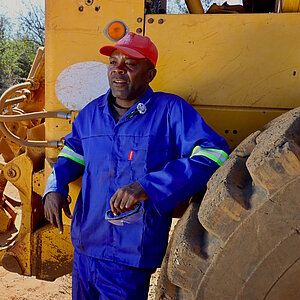
This employment has changed my life and wellbeing in a positive way. I can support my family with it and I see the work to be good.
Making biomass sustainable
Using bush as a resource requires careful management. Harvesting without treating remaining stumps can allow vegetation to resprout rapidly, sometimes resulting in more severe encroachment. Aftercare is therefore an essential part of sustainable biomass production.
Biodiversity also needs to be considered. Bush provides food and habitat for many species, so harvesting must balance biomass supply with ecological needs.
Part of the project is the monitoring of plants, birds, mammals and insects
at project sites before and after harvest. The work helps ensure that restoring grazing land does not come at the expense of biodiversity.
A new rural economy
Namibia’s biomass industry is becoming the foundation of a new rural economy. It is creating jobs across the entire value chain, from bush harvesting and chipping to transport, processing, manufacturing, and energy production.
Anton Gambiseb, a representative of the San Traditional Authority on the Otjituuo Conservancy and Community Forest Management Committee, sees potential for his community. The Otjituuo Conservancy and Community Forest lies within a 100-kilometre radius of the project implementation area and forms part of one of the country’s most bush-encroached landscapes. Pointing to the forest in the background, Anton comments: “For my community, these trees are very important. If everything is managed properly, they provide benefits that can improve our people’s livelihood."
He helps community members understand opportunities linked to sustainable natural resource management and hopes the biomass industry will create livelihoods while supporting the long-term productivity of the land.hancen einer nachhaltigen Nutzung natürlicher Ressourcen zu verstehen. Gleichzeitig hofft er, dass die Biomasseindustrie neue Einkommensmöglichkeiten schafft und langfristig zur Produktivität des Landes beiträgt.
The project’s success in numbers
are expected to be reduced due to the work of the Namibia Biomass project.
Turning a challenge into an opportunity
For Koos, the return of grass means better grazing and more productive land. For Victor, his new job as a machine operator enables him to support his family. For Anton, sustainable biomass management could provide new economic opportunities for rural communities.
At national level, the sector offers Namibia a locally sourced renewable energy resource while creating demand for biomass that would otherwise be a burden on farmers.
By turning an abundant but problematic resource into energy, products and livelihoods, Namibia is developing a new approach to one of its most pressing land and energy challenges.
IKI support to the Mitigation Action Facility
The project is funded by the Mitigation Action Facility. This multi-donor programme provides technical assistance and funding to help implement ambitious mitigation actions. It drives decarbonisation in the three priority sectors energy, transport, and industry. One of its key funding partners is the German Federal Government, which channels support via the International Climate Initiative (IKI).
The link has been copied to the clipboard
Contact
IKI Office
Zukunft – Umwelt – Gesellschaft (ZUG) gGmbH
Stresemannstraße 69-71
10963 Berlin