

Prioritising the restoration, protection and sustainable management of global grasslands: a pathway to achieving Global Biodiversity Targets
Grasslands and savannahs hold significant economic, ecological, and cultural value, encompassing 54% of our terrestrial landscapes. Despite this, these ecosystems are experiencing the highest rate of conversion and degradation. The fragmentation of grasslands has undermined their essential ecosystem functions, including their ability to store carbon, regulate water, provide food, and support cultural practices. One major challenge is that fewer than 10% of grasslands are safeguarded from threats at a global level. They are also often overlooked in national climate and biodiversity plans: only 10% of nationally determined contributions (NDCs) as part of the Paris Climate Agreement include references to rangelands, compared to 70% of those plans including references to forests.
To achieve the targets outlined in the Global Biodiversity Framework (GBF), which was adopted by the Convention on Biological Diversity’s (CBD's) 15th Conference of the Parties (COP15) in 2022, global biodiversity initiatives should prioritise the conservation, restoration, and sustainable management of grasslands to effectively address their rapid degradation and, ensuring the numerous benefits provided by these ecosystems continue for future generations.
The link has been copied to the clipboard
Related Publications
-
 11/ 2025 | Educational material
Grasslands and Savannahs: The Overlooked Climate Heroes
English (PDF, 2 MB)
-
-
10/ 2024 | Educational material
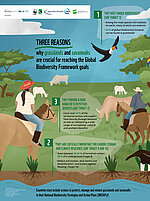
Three reasons why grasslands and savannahs are crucial for reaching the Global Biodiversity Framework goals
English (PDF, 11 MB)