
ACCESS: Accelerating Access to Low Carbon Urban Mobility Solutions through Digitalization
Latin America's transport sector is responsible for 39 percent of greenhouse gas emissions. By accelerating access to low-carbon urban mobility solutions through digitalisation, the project aims to measurably reduce greenhouse gas emissions from the transport sector in urban areas in six Latin American countries. To achieve this, existing and new data and technology solutions will be used to enhance the positive aspects of transport innovations and mitigate the negative aspects. Furthermore, successes and lessons learned in digital development from other sectors will be used to inform project activities and policy recommendations. Transport-related Nationally Determined Contributions (NDC) and Sustainable Development Goals (SDG) will be integrated into the objectives and targets for each country. The project includes activities and outputs at regional, national and city levels.
- Countries
- Argentina, Brazil, Colombia, Ecuador, Mexico, Peru
- IKI funding
- 19,807,539.00 €
- Included preparation phase
- 19,807,539.00 €
- Duration
- 03/2024 till 12/2029
- Status
- open
- Implementing organisation
- United Nations Environment Programme (UN Environment) - Kenya
- Political Partner
-
- Ministry for Agricultural, Territorial and Urban Development (SEDATU) - Mexico
- Ministry of Cities (MCidades) - Brazil
- Ministry of Environment (MINAM) - Peru
- Ministry of Environment and Sustainable Development (MinAmbiente) - Colombia
- Ministry of Transport - Argentina
- Ministry of Transport and Public Works (MTOP) - Ecuador
- Secretariate of Transport - Argentina
- Implementing Partner
-
- Wuppertal Institute for Climate, Environment and Energy GmbH - Germany
- Centro de Movilidad Sostenible
- ICLEI - Local Governments for Sustainability e.V.
- Institute for Transportation & Development Policy (ITDP)
- Massachusetts Institute of Technology (MIT)
- UN-HABITAT
- United Nations Development Programme (UNDP)
- Urban Electric Mobility Initiative
State of implementation/results
- The project operates in Mexico, Argentina, Brazil, Peru, Colombia and Ecuador. Currently, the project team works intensively with political partners on project pilots design and implementation.
- Pilots – Mexico and Brazil: In Mexico City, Monterrey and Puebla, pilot designs progressed on bike‑sharing, better public transport data for trip planning, last‑mile delivery with a focus on women’s safety, and eco‑driving. Monterrey’s public operator agreed to share data to improve monitoring. In Brazil (Rio de Janeiro and Belo Horizonte), pilots advanced on information systems for passengers, active‑mobility monitoring and low‑emission zones (LEZs), including work with universities and technology partners.
- Pilots – Argentina and Ecuador: National and city kick‑off and co‑design workshops (Buenos Aires/La Plata and Quito) refined pilot plans and initial indicators aligned with the project’s monitoring and evaluation framework.
- Pilots – Colombia and Peru: Preparations began for the Digital Readiness Assessment (DRA) in both countries, including the recruitment of national experts through the United Nations Development Programme.
- Policy progress: Mexico and Brazil completed subnational consultations; in Mexico, a national survey on public transport digitalisation was designed with national authorities; in Brazil, consultations supported guidance for the National Mobility Information System (SIMU) and planning for a national training programme on data science for urban mobility. In Argentina and Ecuador, draft recommendations were produced to help cities scale pilot solutions through clearer rules, coordination and funding pathways.
- Regional knowledge: A regional database on transport digitalisation and gender now includes about 106 resources and will be updated regularly. A first gap analysis identified priority needs in operations, active mobility, low‑emission zones and electromobility to guide future training and tools.
- Capacity building: The Training Needs Assessment was completed. The design for a multilingual online learning platform (courses, toolbox and progress tracking) was conceptualized. In 2025, 1,253 people were reached and 625 were actively trained through webinars, e‑learning and in‑person workshops. An in‑person workshop in Mexico engaged 22 cities to accelerate practical uptake.
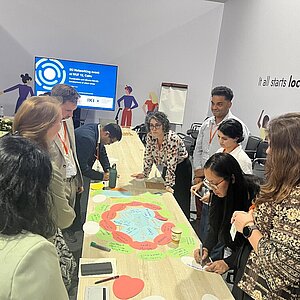
- Events and outreach: The project supported knowledge exchange through monthly working groups and contributions to the United Nations Climate Change Conference pavilion session on “The digital shift toward inclusive, low‑carbon mobility.”
- The Community of Practice (CoP) on Sustainable Transport for Latin America has been formed to engage regional stakeholders, development partners and local authorities. Three webinar sessions were held:
- 1) Digitalization of Public Transport: The Future of Mobility (April 2025)
- 2) Mobility Digitalisation and Implementation Opportunities in Latin America (July 2025)
- 3) Monitoring and Digitalization of Mobility – Experiences and Lessons Learned from Chile (September 2025).
- The ACCESS Digitalisation for Transport (DoT) working group is led by UNEP and UNDP and aims to facilitate the exchange of knowledge and capacity in project countries and throughout the wider LAC region to accelerate uptake of sustainable mobility solutions aided by digitalisation and address cross-cutting issues of gender, equity and financing.
Latest Update:
10/2026
Project relations
Legend:
The link has been copied to the clipboard