
Enhancing landscape resilience to zoonotic disease emergence by consolidating nature conservation systems in Central Asia
Zoonoses as Covid-19 threaten human health globally. The project prevents zoonotic diseases by expanding and improving natural areas and landscapes. It aims to address the relevant causes of epidemic risk and consolidate a fair and effective regional network of protected and conserved areas. The project includes three core components, focusing on: area-based conservation, species management and human and environmental health through good governance. Moreover, activities on disease monitoring, communications and knowledge sharing and environmental and health policy will enhance use of research and technology for zoonotic diseases prevention, and improve awareness raising and national policy. The project will involve institutions, government and non-government organisations, specialist groups, communities including marginalized and most vulnerable groups to climate change and disease outbreaks. The project will have measurable and specific impacts in the five target countries.
- Countries
- Kazakhstan, Kyrgyzstan, Tajikistan, Turkmenistan, Uzbekistan
- IKI funding
- 11,032,937.00 €
- Duration
- 07/2022 till 12/2029
- Status
- open
- Implementing organisation
- International Union for Conservation of Nature (IUCN) - Regional Office for Eastern Europe and Central Asia (ECARO)
- Political Partner
-
- Committee of Environmental Protection of the Republic – Tajikistan
- Ministry of Agriculture and Environmental Protection - Turkmenistan
- Ministry of Ecology, Environmental Protection and Climate Change of the Republic of Uzbekistan
- Ministry of Ecology and natural resources of the Republic of Kazakhstan
- Ministry of Natural Resources, Ecology and Technical Supervision – Kyrgyzstan
- Implementing Partner
-
- CAMP Alatoo - Kyrgyzstan
- Inst. of Zoology of the Academy of Sciences of the Republic of Uzbekistan
- Institute of Zoology of Kazakhstan
- Michael-Succow-Foundation / Michael Succow Stiftung
- Secretariat of Convention on the Conservation of Migratory Species of Wild Animals (CMS) - Deutschland
- Tajikistan Nature Foundation (TNF)
- UNEP World Conservation Monitoring Centre (WCMC)
- Zoological Society of London (ZSL) - United Kingdom
State of implementation/results
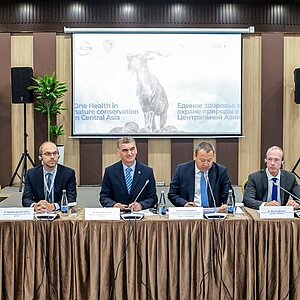
- The second 1Health4Nature webinar was held on 9 December 2025, with 233 registrations and 116 attendees. It gathered practitioners, policymakers and researchers from Central Asia to discuss how OECMs contribute to biodiversity conservation and the implementation of the Global Biodiversity Framework (GBF) while supporting the One Health approach (iucn.org/…)
- During the IUCN World Conservation Congress Forum, the session “Species Monitoring for Conservation and Zoonotic Disease Prevention in Central Asia” (11 October 2025) highlighted how new technologies and field approaches support wildlife monitoring, help identify emerging zoonotic risks and strengthen prevention under the One Health approach. Speakers represented IUCN ECARO and partner organisations, including the Tajikistan Nature Foundation.
- 1Health4Nature session at the Congress, “The Role of Communities in Nature Conservation within the One Health Approach” (12 October 2025), highlighted the role of local communities in safeguarding ecosystem and human health. Herders, rangers and community members contribute to early detection of environmental and health risks, strengthen biosecurity and support sustainable ecosystem management. Speakers included representatives from IUCN ECARO, CAMP Alatoo Public Foundation (Kyrgyzstan) and the Tajikistan Nature Foundation. (iucn.org/…)
- In December 2025, the Government of Kazakhstan adopted the Concept for the Conservation and Sustainable Use of Biodiversity for 2026–2035, establishing the national policy framework and action plan for biodiversity conservation coordinated by the Ministry of Ecology and Natural Resources. IUCN experts contributed to the policy development process by providing targeted inputs to integrate the One Health approach, strengthening the overall framework and supporting alignment with international best practices.
- On 26-28 August 2025, the IUCN Central Asia project held its annual coordination meeting at the Institute of Zoology (Kazakhstan) with partners from across Central Asia. The meeting reviewed progress on protected area governance, biodiversity monitoring and zoonotic disease prevention, advanced the IUCN Green List process through initial PCA assessments, and highlighted the need for harmonized species monitoring protocols. WHO, WOAH and FAO joined online to discuss zoonotic disease monitoring methods and results in Kazakhstan.
- By the end of 2025, the project initiated monitoring of 21 species and species groups in pilot sites across Central Asia, generating baseline data on populations, habitats, threats and human–livestock interactions to support conservation and zoonotic risk prevention.
Latest Update:
10/2026
Project relations
Legend:
The link has been copied to the clipboard