
Growing smarter – sustainable mobility in East Africa
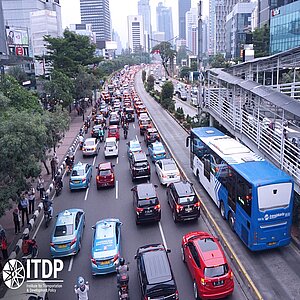
The rapid growth in African cities leads to traffic jams and uncontrolled urban sprawl – and the consequences are rising greenhouse gas emissions, air pollution, urban poverty and climate vulnerability. The project helped to avoid this and reduce greenhouse gas emissions in the transport sector at the same time by supporting public & non-motorized transport and urban planning in the target countries. It also supported the implementation of high-quality public transport systems in Addis Ababa, Nairobi, Kigali and Kampala and the expansion of the existing bus rapid transport system in Dar es Salaam. The integration of public transport with cycling and walking was improved and urban development along transport corridors was addressed. The project also promoted policy frameworks at urban and national levels, accelerating changes in the transport sector through quality standards, improved financing and other policy measures.
- Countries
- Ethiopia, Kenya, Rwanda, Tanzania, Uganda
- IKI funding
- 4,998,829.00 €
- Duration
- 09/2018 till 02/2026
- Status
- completed
- Implementing organisation
- Institute for Transportation & Development Policy (ITDP)
- Political Partner
-
- Ministry of Infrastructure Rwanda
- Ministry of Roads and Transport - Kenya
- Ministry of Transport and Logistics - Ethiopia
- Ministry of Works and Transport (MOWT), Uganda
- President’s Office, Regional Administration and Local Government - Tanzania
- Implementing Partner
-
- UN-HABITAT
- Online
State of implementation/results
- In August 2023, a conference was organized under the theme Sustainable Cities through Transport: Improving Financing Mechanisms and Institutional Capacity. The conference took place in Addis Ababa, Ethiopia, from 9-10 August 2023 and brought together 74 participants from 11 countries. The conference explored opportunities to secure financing for various kinds of sustainable mobility initiatives.
- In October 2022, ITDP organised the fourth annual sustainable transport conference in collaboration with the City of Kigali and UN-Habitat. The regional conference, Transit-Oriented Development: Planning for Diversity and Social Inclusion, convened 77 delegates, including senior officials from urban development, transport, and lands ministries; local governments; and road agencies in the African region.
- Publication of the Study "Why Infrastructure Matters: Active mobility, public transport and economic growth" (africa.itdp.org/…).
- Ethiopia:
- The Addis Ababa Transport Bureau, with support from ITDP’s IKI-supported project, is developing a four-year Non-Motorised Transport Implementation Plan, the third Implementation Plan under the NMT Strategy, outlining a set of immediate actions that can be taken to improve the walking and cycling environment. The Implementation Plan accompanies the 10-year Addis Ababa Non-Motorized Transport Strategy, which identifies key goals, quantitative indicators, and implementation targets.
- The project supported the Addis Ababa Transport Bureau in developing a cycle network plan for the city. The plan proposes a phased implementation plan to build out a high-quality cycle network over the short, medium, and long terms. The Addis Ababa City Administration has implemented 100 km of high-quality walkways and cycle tracks as part of the Corridor Development Project, with another 76 km under design. ITDP is assisting the city with design reviews for various corridors.
- ITDP supported the Ministry of Urban Infrastrcture and Ministry of Transport and Logistics, Ethiopia, in developing the Ethiopia Urban Street Design Manual and an accompanying online tool.
- ITDP is reviewing operational plans and infrastructure designs for various BRT projects, including the B2, B3, B4, and B6 corridors.
- Kenya:
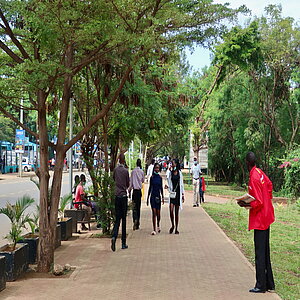
- The project is supporting Nairobi City County with the design of streets in the Nairobi central business district and the Westlands district. The project aims to create equitable and inclusive streetscapes that wider footpaths, safe pedestrian crossings, street trees, and organised parking areas for public transport vehicles. ITDP is supporting the evaluation of the construction process and providing continuous feedback to improve the quality of the NMT infrastructure. Under the project, NCC upgraded walkways on several streets in the Nairobi CBD. One of the corridors, Tom Mboya Street, now features a wide median walkway, which has become a popular public space.
- The project is supporting implementation of enhanced non-motorized transport in the City of Kisumu: improved streets will include wider footpaths, protected bike lanes, pedestrian crossings, and other street elements that will enhance the safety and comfort of pedestrians and cyclists.
- In partnership with the Nairobi Metropolitan Area Transport Authority, ITDP developed a travel demand model for public transport services in greater Nairobi as a basis for a public transport service plan.
- Rwanda:
- The project supports the city of Kigali in the implementation of a rapid bus system as well as in the development of master plans to align urban and transport planning based on the principles of transit-oriented development and to plan charging infrastructure for electric buses.
- In partnership with the City of Kigali, a Parking Management Strategy for Kigali was prepared. The strategy calls for increasing on-street parking fees to reflect market demand and improving enforcement mechanisms to prevent parking on footpaths.
- In early 2025, ITDP and UN-Habitat, in collaboration with MININFRA, began developing Rwanda's first national urban street design guide to create safer, more inclusive, and sustainable streets nationwide.
- Tanzania:
- The project supported plans for an extension of the Dar Rapid Transit (DART) BRT system and for walking and cycling improvements.
- DART, the Ministry of Lands, and municipal governments are developing localised transitoriented development (TOD) policies for Dar es Salaam with support from the project. The policies will include corridor-wide regulations to guide elements such as zoning, parking requirements, and building facades.
- ITDP supported DART with the introduction of a TOD-based Local Area Plan (LAP) for the Gerezani Terminal.
- Uganda:
- The Ministry of Works and Transport, Kampala Capital City Authority, and development partners are developing a roadmap for BRT implementation in Kampala with technical assistance from the project. The project is also supporting the preparation of infrastructure designs for the planned BRT corridors.
- ITDP is working with KCCA to review key roads in the Central Business District. The goal is to reduce parking spaces, widen sidewalks and bike lanes, and create trees and safe pedestrian crossings.
Latest Update:
04/2026
Further links
Project relations
Legend:
The link has been copied to the clipboard