
Supporting the Nitric Acid Climate Action Group (NACAG)
During the production of nitric acid, large amounts of climate-damaging nitrous oxide (N2O) are released into the atmosphere. Although avoiding these emissions is technically relatively simple and comparatively inexpensive, most nitric acid plants are not equipped with the respective technology. NACAG's goal is to create incentives for the permanent reduction of nitrous oxide emissions. The global mitigation potential over the next ten years is well over one gigaton of CO2e. To this end, it provides both technical and political support: the initiative advises governments on the long-term regulation of these emissions and helps integrate the sector into Nationally Determined Contributions (NDCs). Besides, it finances the installation and operation of climate technology in eligible production facilities. Partner countries must provide a binding commitment to continue mitigation activities under their responsibility from 2024 onwards to qualify for funding.
- Countries
- Argentina, Bosnia and Herzegovina, Colombia, Cuba, Georgia, Indonesia, Jordan, Mexico, Pakistan, Peru, Thailand, Tunisia, Uzbekistan, Viet Nam, Zambia, Zimbabwe
- IKI funding
- 50,727,000.00 €
- Duration
- 11/2016 till 12/2028
- Status
- open
- Implementing organisation
- Deutsche Gesellschaft für Internationale Zusammenarbeit (GIZ) GmbH
- Political Partner
-
- Diverse climate change relevant institutions in the respective partner countries/Diverse klimarelevante Institutionen in den entsprechenden Partnerländern
- Federal Ministry of Environment and Tourism - Bosnia and Herzegovina
- Ministry of Agriculture - Georgia
- Ministry of Climate Change - Pakistan
- Ministry of Ecology and Environment - China
- Ministry of Economy - Argentina
- Ministry of Economy and Finance of the Republic of Uzbekistan
- Ministry of Environment (MINAM) - Peru
- Ministry of Environment - Jordan
- Ministry of Environment - Tunisia
- Ministry of Environment and Natural Resources (SEMARNAT) - Mexico
- Ministry of Environment and Natural Resources Management - Zimbabwe
- Ministry of Environment and Sustainable Development (MinAmbiente) - Colombia
- Ministry of Industry - Indonesia
- Ministry of Natural Resources and Environment (MoNRE) - Thailand
- Ministry of Science, Technology and the Environment (CITMA) - Cuba
State of implementation/results
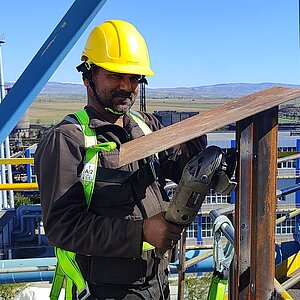
- In Georgia, the emission reduction technology was installed in the fall of 2025, and the monitoring equipment was successfully commissioned. With the installation of this technology, Rustavi Azot will now save approximately 430,000 metric tons of CO₂ equivalents annually. This reduction is equivalent to the emissions from over two million passenger flights from Tbilisi to Berlin. In addition, Rustavi Azot invested significant funds of its own (50% of the total costs) in the new technology and committed to covering all operating and maintenance costs in the long term. This is a clear and sustainable commitment to climate-friendly industrial production.
- Following consultation with NACAG, the facility in Peru decided to cover the costs of procuring and installing the N2O reduction and monitoring system on its own. The equipment was installed in 2024. NACAG is now advising the facility and the Ministry of the Environment on the monitoring and reporting of N2O emissions and has developed an MRV tool for this purpose.
- Financing agreements for the procurement and installation of nitrous oxide abatement technology have been concluded with nitric acid producers in Mexico, Georgia, Zimbabwe, Tunisia, Jordan, Uzbekistan, Colombia, and Argentina. The direct abatement potential at these partner facilities amounts to approximately three million metric tons of CO2 equivalents.
- Eighteen companies have applied for NACAG funding to install emission-reduction technology. Eleven facilities have received financing agreements totaling approximately 27 million euros. This demonstrates the interest of both the private sector and government-run facilities in the initiative.
- Mexico, Colombia, Tunisia, Pakistan, Zimbabwe, Jordan, Peru, Uzbekistan, and Vietnam have included the nitric acid sector in their current NDCs (with a total reduction potential of 5 million tCO2e per year).
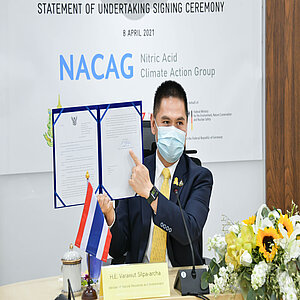
- Funding from NACAG is contingent upon the signing of the Statement of Undertaking. The Statement of Undertaking commits signatories to implementing appropriate regulations to ensure that the nitric acid sector remains low-emission in the long term. To date, the Statement of Undertaking has been signed by Georgia, Mexico, Thailand, Tunisia, Zimbabwe, Argentina, Pakistan, Peru, Colombia, Jordan, and Uzbekistan.
Latest Update:
10/2026
Project relations
Legend:
The link has been copied to the clipboard


![[Translate to English:]](/fileadmin/_processed_/b/e/csm_2023043_NACAG_AdobeStock_162896684_Alexsei_96f01275b9.jpeg)