
The IKI develops further
In 2024, the International Climate Initiative (IKI) worked on numerous measures to further improve its processes and impact as a funding programme.
New Open Application Platform launched for ideas competitions
The IKI relies on funding instruments precisely tuned to its projects. The central elements include Thematic Calls, Country Calls, IKI Medium Grants and IKI Small Grants as competitive selection procedures.
In order to simplify the submission of project outlines for the ideas competitions, Zukunft – Umwelt – Gesellschaft (ZUG), as the project management agency, and the Gesellschaft für Internationale Zusammenarbeit GmbH (GIZ), as the implementer of the IKI Small Grants, have redesigned the online platform. As a result, the IKI now provides the large variety of implementing organisations with a clear framework including numerous aids to enable a smooth application process. The automatic storage and comparison of data in particular support the quality and innovation potential of project outlines as well as the capabilities of the interested implementing organisations.
The link to the online platform can be found on the pages of the respective funding call. Current calls can be accessed via the ‘Find funding’ overview page.
Gender Action Plan comes into force
Effective climate action and biodiversity conservation arise from successful cooperation. However, the people involved contribute various identities, social and educational backgrounds, gender-specific needs and perspectives. The IKI deliberately takes this diversity into consideration in its work. This is also reflected in the IKI strategy, which states gender justice as a success factor for project implementation.
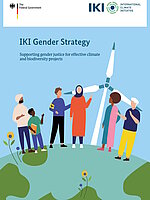
Since 2021, the IKI Gender Strategy has defined the overarching objectives for the promotion of gender justice. A conception and piloting phase in 2022/23 was followed by the Gender Action Plan (GAP), in which short and medium-term objectives and measures are formulated, and which has been in the implementation phase since the beginning of 2024. The Gender Action Plan initially has a duration until January 2026 and pursues three overarching objectives:
- More effective climate action, a higher level of resilience to the impacts of climate change and improved biodiversity conservation through the additional promotion of gender justice.
- Social realisation of gender justice, at minimum through the use of gender-transformative approaches and gender-responsive project planning and implementation.
- Avoidance and reduction of gender-based disadvantages and unequal treatment by means of specific measures.

The Gender Action Plan addresses the five strategic fields of action of the IKI gender strategy and underlines them with specific measures. For example, the quality of gender-responsive approaches in outlines is used as an additional selection criterion for new projects in the field of action “specifications for implementing organisations and the adaptation of processes”.

Gender Community of Practice introduced
The IKI Gender Community of Practice (IKI G-CoP) is a new communication format with the implementing organisations. It improves the exchange of knowledge and experience in the implementation of the IKI Gender Strategy and the promotion of gender justice within the scope of the projects.
“From theory to practice” - this was the slogan under which the IKI introduced the G-CoP in March 2024. During the course of the year, it established itself as an important component for gender mainstreaming in IKI projects. The format is characterised by continuous further development and the high degree of participation of those taking part.
Further forms of support offered for the improvement of data quality for the IKI standard indicators
The IKI uses standard indicators (SI) to collect data on selected results and impacts from its overall funding programme. For individual projects, the SIs complement the project’s own specific targets and indicators. Since 2021, the SI Helpdesk at the ZUG has evaluated the standard indicators on an annual basis.
To improve the data quality of the standard indicators, the SI Helpdesk is continuously developing further forms of support for projects and offers individual project-specific consultation. Following the online seminars for “SI 1 - Mitigation”, the SI Helpdesk organised FAQ sessions for projects in spring 2024. Further forms of support for the waste sector and the specific challenges of fund projects are currently in preparation.
The service page ‘Information on IKI standard indicator 1 - Mitigation’ provides more detailed information and guidance on standard indicator 1 - Mitigation
Local Content becomes Local Action
Close involvement of actors in the partner countries of IKI projects and an intense orientation to the local context have always been a quality feature of IKI projects. The significant participation of local actors in the shaping, management and implementation of the projects is extremely valuable.
Therefore, at least half of the IKI funding for the most IKI projects must be implemented by organisations anchored in the partner countries/regions, where they generate added value and offer jobs and training to local specialists.

Upon publication of the IKI Thematic Call 2024, this requirement was renamed from Local Content to Local Action in order to create a differentiation from existing international definitions, such as the WTO definition of “local content”, and to emphasise the implementation-oriented nature of the concept, which was defined in the IKI Strategy up to 2030. The content and definitions of the local action regulation, which has applied in the IKI since 2022, will not change.
IKI Annual Report 2024
This article is part of the IKI Annual Report 2024.
The link has been copied to the clipboard