
Support for ambitious NDCs and their implementation
In 2025, the International Climate Initiative (IKI) focused on supporting its partner countries in submitting and implementing ambitious Nationally Determined Contributions (NDCs).
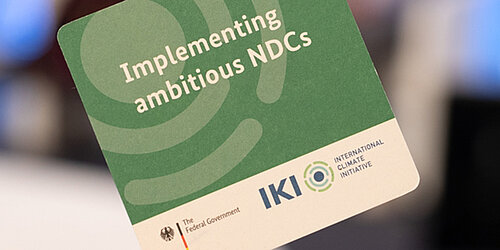
Providing support for partner countries in the development and implementation of high-quality and ambitious Nationally Determined Contributions (NDCs) is an overarching goal of the International Climate Initiative (IKI).
In 2025, this represented a key piece of policymaking: under the Paris Agreement, all countries were obligated to submit more ambitious NDCs with a target for the year 2035. At the World Climate Conference (COP30) in Belém, Brazil, the first full ambition cycle of the Paris Agreement was also adopted.
The Global Stocktake (GST) from 2023 shows that the nationally determined contributions and the measures submitted so far are not sufficient to reach the targeted reductions in emissions required to achieve the 1.5 °C target. The NDCs for 2035 are the last chance to keep this a viable ambition. The synthesis report of the United Nations Framework Convention on Climate Change (UNFCCC) proves that the NDCs for 2035 submitted by 86 countries by 9 November 2025 are not sufficient. The NDCs must not only scale up ambitions, but also close the gap in terms of their implementation.
The IKI provides various formats to support its partner countries in implementing these measures. In 2025 alone, the IKI contributed to developing more ambitious NDCs in 71 countries. This support includes coordinating the update process to ensure submission in due time, preparing stocktakes of NDC implementation performed so far, defining models and scenarios as the basis for ambitious objectives, developing financing strategies and competence, and establishing highly complex transparency and tracking systems.

A large part of the IKI’s support is provided within the framework of the NDC Partnership, a globally established initiative in the area of NDC implementation and further development. This initiative coordinates and pools offers of support from donor countries as well as the expertise and competencies of implementing organisations, in order to guarantee demand-oriented support in partner countries. Germany is a founding member of the partnership, which was initiated in 2016, and is to date an active member of the Steering Committee. At the same time, Germany is the largest financial donor through the IKI and the Federal Ministry for Economic Cooperation and Development (BMZ).
The IKI’s support programmes are derived from ongoing and planned IKI projects. Central projects and initiatives intended to flexibly address the needs of partner countries as part of the NDC Partnership are, in particular:
- The Climate Promise from the United Nations Development Programme (UNDP): industrial decarbonisation, energy, investment planning and financing strategies.
- The UNDP’s SCALA programme and the United Nations Food and Agriculture Organisation (FAO): NDC development and implementation in the adaptation, land use and agriculture sectors.
- Act & Invest from the United Nations Environment Programme (UNEP): this assesses financial requirements and financing gaps and provides support for the development of investment plans, project pipelines and capacity building.
- The IEA’s Clean Energy Transition Programme (CETP): NDC development in the energy sector, including modelling and implementation.
- The Partnership Action Fund (PAF): the NDC Partnership also maintains a fund to provide technical support to partner countries if there are no suitable support programmes available from donor countries for urgent needs.
- Numerous bilateral, regional and global IKI projects.
Interface projects in the IKI priority countries are also an important component of the IKI’s support. Interface projects call on international experience, promote capacity building and develop financing strategies for the implementation of the NDCs. In addition, well-known scientific reports and NDC analyses were funded to draw attention to gaps and potential for ambitious climate action, such as the UNEP Emission Gap Report 2025, the Climate Action Tracker and the report Investing in Climate for Growth and Development from the Organisation for Economic Co-operation and Development (OECD) and the UNDP.
funding
was committed by the IKI in 2025 for projects that support the financing of the socio-ecological transformation.
The IKI’s support made an impact. By the end of 2025, 128 countries, which account for approximately 78 percent of the global greenhouse gas emissions, had submitted new NDCs. Many countries scaled up their ambition and oriented their NDCs towards their net zero targets. The energy sector, which is one of the areas with the greatest mitigation potential, has now become part of the NDCs of all countries. 90 percent of the NDCs of developing countries also comprise adaptation components. With the support of the NDC Partnership, 68 developing countries have prepared implementation and investment plans for their NDCs. The new NDCs are also more strongly embedded in national development priorities and processes. More than 50 developing countries received support for integrating NDCs into planning, budgetary and investment frameworks. Today, gender equality and social inclusion are included in the NDCs of 95 percent of the 128 countries. More than 90 percent acknowledged concepts for a just transition and consequentially the need for a fair, socially compatible transformation.
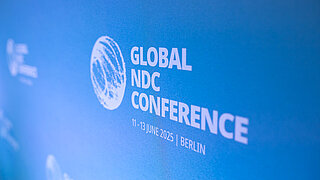
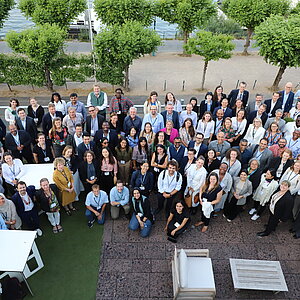
The Global NDC Conference, hosted by the German Federal Government, is an international forum for exchange on NDCs that takes place every two years. A panel of experts from business and civil society as well as policymakers from all over the world share their experiences there, assume responsibility and contribute to actively shaping their country’s NDC process. In 2025, the conference, which was funded by the IKI, again provided an opportunity to present new ideas, establish networks, and discuss the planning and implementation of NDCs.
The NDC support in 2025 was a paramount issue of the IKI funding instrument IKI Compete and one of the overarching goals of the IKI strategy up to 2030. The IKI Large Grants, initiated for the first time at COP30, was looking for project ideas in four priority countries and thematic areas that directly promote the implementation of NDCs. In its annual call, the Mitigation Action Facility (MAF), which is co-financed by the IKI, is also looking for NDC implementation projects in the central sectors of energy, industry and transport.
Project overview 2025
Projects started





IKI Annual Report 2025
This article is part of the IKI Annual Report 2025.
The link has been copied to the clipboard