
Guardians of the sea: combatting ghost fishing in Colombia
With support from Germany’s IKI Small Grants, the local organisation ECOMARES tackles ghost fishing, a serious threat to marine life in Colombia.
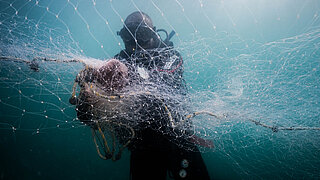
The Gulf of Tribugá, located on the Pacific coast of Colombia, is home to diverse biodiversity and traditional communities. It is strewn with beaches, pristine humid tropical forests, and mangroves. Against this backdrop, Nelly Ibargüen takes a deep breath, pulls her diving goggles over her head and dives headfirst into the turquoise water. When she reappears, she throws a few fishing hooks, lines and some torn-off pieces of a fishing net into the boat; remnants of fishing gear that can continue harming marine life long after being abandoned or lost.
These so-called ‘ghost fishing gears’ lie in wait like ghosts on reefs, continuing fishing on their own. This jeopardises the rich biodiversity of the region and reduces fish stocks, which puts pressure on the ecosystem and negatively affects local communities that depend on them. The local communities, however, are not only affected by this issue. They are at the heart of the solution.
Protection of the reefs
“I came here to do my bit for these defenceless species in the sea”, says Nelly Ibargüen. She is one of the certified divers of “Guardians of the Sea,” a community-led initiative dedicated to safeguarding the reefs.
Divers removed 224 kilograms of ghost fishing gear from 22 hectares of marine habitat.
That is roughly the weight of a fully-grown dolphin. Additionally, 124 fishers participated in awareness-raising activities and committed to sustainable fishing practices to prevent gear loss.
This initiative builds on a local process initiated in 2016 by the Kakiri Diving Center and the Community Council “Los Riscales” of Nuquí, a village in the Gulf of Tribugá lLocated in the North Pacific coast of Colombia. It stems from local knowledge and community commitment to protecting the marine environment that sustains their livelihoods.
With support from Germany’s IKI Small Grants, the Colombian NGO ECOMARES has strengthened and connected these local efforts. The organisation works with the Guardians of the Sea and various local actors, creating a unified front against ghost fishing. Divers remove harmful gear, while fishers develop prevention strategies and community members explore ways of reusing recovered materials.
Local communities drive impactful solutions
Around 16,000 individuals from Afro-Colombian and indigenous communities live in the region. Ghost fishing not only harms marine biodiversity but also impacts the livelihoods of these communities, as many rely on fishing for food security and economic sustenance. The strength of this initiative lies in the local community's engagement, as those directly affected by the ecosystem are the ones taking action. Nelly is also a member of the Community Council “Los Riscales” in Nuguí.
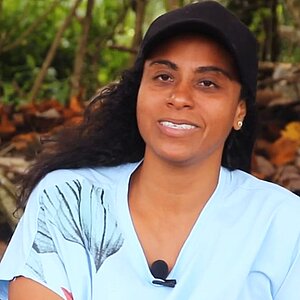
When we clean up the rocky reefs, we are also talking about long-term food security.
Circular, locally crafted products

The initiative goes beyond merely removing ghost fishing gear: it also addresses the potential value of the recovered materials. Local waste management options are limited, prompting the project to explore meaningful uses for the collected gear. “For me, it means transforming waste that once threatened our marine species into something beautiful and functional. With every piece we make, I feel we are turning an environmental problem into a solution full of purpose,” says Yuliza Cabrera, a participant in the creative recycling laboratory.
Through this laboratory, local women and artisans are experimenting with various uses for the materials, creating prototypes for accessories, bags or household objects. The process is still exploratory, but it opens a conversation about how materials that once harmed marine life could be transformed into something useful.
The experience in the Gulf of Tribugá exemplifies the importance of locally led climate and biodiversity action. Communities are not merely beneficiaries; they actively identify challenges, develop solutions, and implement them. And that is why they will sustain the project’s results long after it has come to an end.
The Role of IKI Small Grants in Sustainable Change
IKI Small Grants provides essential resources, technical support, and opportunities for local solutions to flourish. ECOMARES plays a crucial role in connecting local actors, enhancing their capacities, and facilitating the testing of new approaches. The initiative's long-term success lies in the community's ownership of knowledge and responsibilities. The Guardians of the Sea can continue protecting the reefs, fishers can apply and share sustainable practices, and artisans can explore innovative uses for recovered materials.
This project illustrates how a time-bound grant can foster enduring change: not by creating dependency on external funding, but by empowering the community so that it can continue to drive the solution forward.
As Nelly dives into the turquoise water this time, she appreciates the vibrant marine biodiversity and takes pride in her contributions to its protection, symbolised by a necklace crafted from fishing nets she has collected herself.
About IKI Small Grants
IKI Small Grants is strengthening local solutions for effective climate and biodiversity action. It is part of the International Climate Initiative (IKI), commissioned by the Federal Ministry for the Environment, Climate Action, Nature Conservation and Nuclear Safety (BMUKN). IKI Small Grants fosters bottom-up solutions while strengthening capacities of local actors. It is run by Deutsche Gesellschaft für Internationale Zusammenarbeit (GIZ) GmbH.
The link has been copied to the clipboard
Contact
IKI Office
Zukunft – Umwelt – Gesellschaft (ZUG) gGmbH
Stresemannstraße 69-71
10963 Berlin
About the organisation
ECOMARES is an NGO, established in 2009 in Colombia. Its vision is to contribute to research, conservation, and restoration of biological diversity, especially marine ecosystems. In addition to its conservation objectives, ECOMARES aims to be an organisation recognized nationally and internationally for the excellent technical quality of its work, for its high professional level and dynamism, and for its positive influence on knowledge and preservation of the natural heritage.