
How Carbon Credits Are Advancing Climate-Friendly Cooling
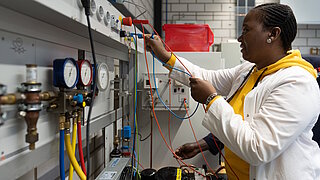
A funding programme in southern Africa is introducing energy-efficient air conditioners that use natural refrigerants to the market — harnessing carbon markets to finance the transition over the long term.
The number of air conditioners in southern Africa is expected to rise from 5.4 million to around 17.7 million by 2030 – along with greenhouse gas emissions in this sector. The International Climate Initiative (IKI) is addressing this trend by developing a funding programme for climate- and environmentally friendly air conditioners in the region.
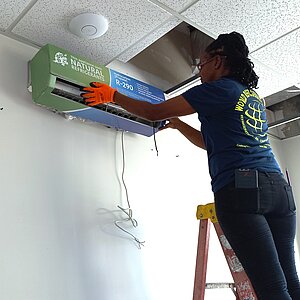
One component of the “Cooling Programme for Southern Africa” aims to establish air conditioners using natural refrigerants in the market. The partner countries Botswana and Eswatini received the first “green” air conditioners in December 2025. These units were financed by the project and will be used for training and demonstration purposes.
Triple benefit: cost-effective as well as climate- and environmentally friendly
The new units can be used for both cooling and heating and are characterised by high energy efficiency. They also operate using the natural refrigerant propane (R290). Unlike synthetic refrigerants, propane is climate- and ozone-friendly and does not produce harmful decomposition by-products.
Good to know: An energy-efficient air conditioner using propane can avoid up to 24.1 t CO₂eq over a ten-year operating lifetime. This corresponds to seven return flights from South Africa to Germany. Put differently, during this period the unit consumes up to 27,100 kWh less electricity than a conventional system – and users save several thousand euros in energy costs.
No green transformation without qualified specialists
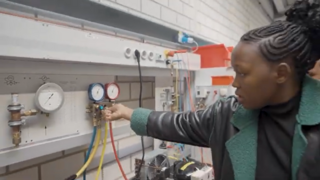
Propane is best known as a cooking gas; it is therefore highly flammable. Installation and maintenance may only be carried out by qualified specialists who observe the necessary safety precautions. Well-trained technicians also know how proper installation and regular maintenance can prevent leaks and improve the energy efficiency of air conditioners – regardless of the refrigerant used.
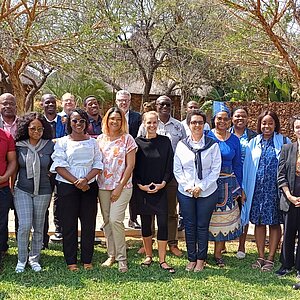
To ensure correct installation and maintenance of the new units, the “Cooling Programme” trains around one hundred specialists per partner country. In addition to Botswana and Eswatini, the project’s partner countries include South Africa and Namibia.
A particular focus is placed on promoting female technicians – they are urgently needed for the energy transition, yet frequently experience discrimination in this male-dominated sector.
Kick-starting green air conditioners
By the end of the project in December 2027, more than ten thousand green air conditioners are expected to be imported into the partner countries and sold to end customers. The main barrier to market entry is that energy-efficient propane air conditioners are more expensive to purchase than those using synthetic refrigerants. This is because they are still produced in smaller quantities.
The higher purchase price discourages potential customers, even though it is more than offset during operation through lower energy consumption. The “Cooling Programme” therefore provides import companies with a subsidy, enabling the environmentally friendly units to be sold at the same price as conventional systems.
Upscaling and sustainability: harnessing the mechanisms of carbon markets
To prevent sales from declining after the project ends, subsidies are to be financed through carbon markets in the future. The basis for this is Article 6 of the Paris Agreement.
The idea behind this is that carbon markets should drive climate action by enabling mitigation measures to take place where they are most cost-effective. The “Cooling Programme” supports partner countries in creating the necessary conditions by contributing to the development of regulatory frameworks:
The first step towards a functioning carbon market is the development of national carbon market frameworks, which describe how the carbon market in each country is organised and ensure that emissions reductions are not counted twice.
The Mitigation Action Design Document (MADD) describes the mitigation activity to be marketed – in this case, the transition from climate-damaging to more climate-friendly air conditioners. MADDs are already available for all four partner countries and are currently being validated by TÜV. Completion is expected in June 2026.
Following successful validation, countries offering carbon credits can engage with potential buyers, such as companies or countries with high greenhouse gas emissions. The project supports its partner countries in identifying interested parties and facilitating discussions.
Revenues are to be invested in subsidies for additional units or further measures promoting sustainable cooling.
Outlook: climate action with signalling effect
The “Cooling Programme for Southern Africa” demonstrates how technological innovation, skills development and international climate finance can work together. If green air conditioners can be permanently financed through carbon markets, a scalable model for sustainable cooling will emerge – benefiting the climate, the economy and society far beyond the region.
The link has been copied to the clipboard
Contact
IKI Office
Zukunft – Umwelt – Gesellschaft (ZUG) gGmbH
Stresemannstraße 69-71
10963 Berlin
Further information
Funding priority
Promoting the energy transition