
Kenya: From Global Climate Policy to Local Impact

A high-level German delegation has visited southern Kenya to assess progress under the AREECA Forest Landscape Restoration project—an IKI flagship that demonstrates how global climate finance can deliver tangible benefits for ecosystems and communities alike.
The delegation was led by Rita Schwarzelühr-Sutter, Parliamentary State Secretary at the Federal Ministry for the Environment, Climate Action, Nature Conservation and Nuclear Safety, and accompanied by German Ambassador to Kenya Sebastian Groth.
The visit in Kajiado County offered an opportunity to review five years of implementation of the project, which is funded by Germany’s International Climate Initiative (IKI) and is coming to a close at the end of this year.
Community Conservancies Driving Restoration
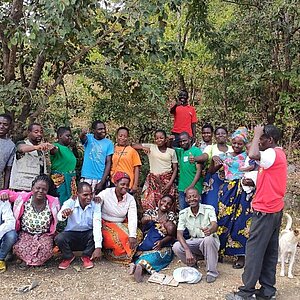
A key stop of the field visit was the Amboseli Land Owners Conservation Association (ALOCA) community conservancies. The delegation was welcomed by local leaders and members of a Maasai women’s cooperative, highlighting the central role of communities in climate-resilient land management.
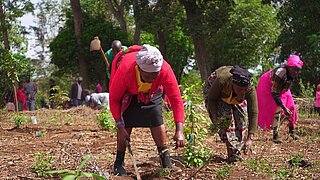
Together, they took part in the construction of earth bunds—low earthen structures that slow surface runoff, improve water infiltration and create grass regeneration hubsthat support the recovery of degraded drylands. The conservancies are community-owned, with shared tenure among predominantly Maasai landowners. Restoration activities were presented by Ivan Kiptui, WWF-Kenya Rangeland Officer, together with Samuel Kaanki, Chairman of the ALOCA Conservancy.
Climate-Resilient Forests and Water Resources
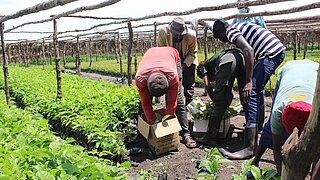
The delegation also visited a Kenya Forest Service (KFS) model tree nursery established under the IKI-project to support the restoration of native forests and agroforestry systems. Due to heavy rainfall that was long awaited in the area, the programme was adjusted and the visit continued to the Laimurunya natural spring.
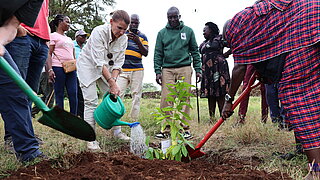
Community representatives explained spring protection and restoration measures, including fencing, afforestation and participatory water management. Joseph Nkoreo, Chairman of the Community Spring Committee, and Beatrice Mwangi from the Water Resource User Association (WRUA) highlighted the importance of safeguarding ecosystem flows for downstream users. To mark the success of the restoration efforts, the delegation planted several symbolic trees, underscoring the strong partnership between the German and Kenyan governments, community institutions and the IKI-supported AREECA project.
A Landscape Approach for Climate, Nature and Livelihoods
Throughout the visit, discussions highlighted that Amboseli National Park—a globally significant biodiversity hotspot—is highly dependent on surrounding private and community conservancies and on the health of upstream ecosystems, including those on the slopes of Mount Kilimanjaro. The field visit illustrated how an integrated, landscape-level approach—linking restoration, conservation and livelihoods—is essential to maintaining ecosystem functions while enhancing climate resilience and income opportunities for local communities.
Scaling Impact Through Climate Finance
The delegation also observed how synergies between AREECA and a project funded by the German Federal Ministry for Economic Cooperation and Development have increased impact in the landscape, particularly through improved livestock management practices that complement restoration measures. Overall, the visit demonstrated how IKI, combined with strong partnerships and community leadership, can deliver measurable ecological and socio-economic benefits at scale.
The link has been copied to the clipboard
Contact
IKI Office
Zukunft – Umwelt – Gesellschaft (ZUG) gGmbH
Stresemannstraße 69-71
10963 Berlin