

Recognition, protection and strengthening of indigenous and local communities
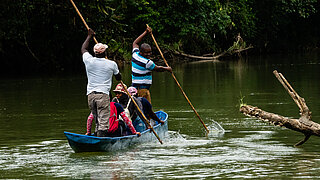
Saturday, 9 August, marks the International Day of the World’s Indigenous Peoples. The IKI provides targeted support for projects to strengthen their rights and incorporate their perspectives into national and international biodiversity and climate action processes.
Indigenous peoples and local communities (IPLCs) manage more than a third of the global land area, including many of the most biodiverse and ecologically valuable areas on the planet. (WWF report: “The state of Indigenous Peoples‘ and Local Communities’ lands and territories”). The International Day of the World’s Indigenous Peoples reiterates the United Nations' message on protecting and strengthening the rights of indigenous peoples. This day also acknowledges their cultural diversity, their deeply rooted connection with nature, and their central role in the preservation of biodiversity and in climate change mitigation.
Despite their key role, many representatives of indigenous peoples find themselves confronted with legal uncertainties, the loss of their habitats, and limited access to political decision-making processes. Therefore, 9 August calls for the recognition of their rights and greater participation in global climate and biodiversity policies.
Game-changing decision at the CBD COP in Cali

An important step was decided upon at the 16th Conference of the Parties (COP 16) of the UN Convention on Biological Diversity (CBD) in December 2024 in Cali, Colombia: the establishment of a Subsidiary Body on Indigenous Peoples and Local Communities – a permanent subsidiary body that grants IPLCs a formalised and permanent role in the CBD implementation architecture.
This new body will ensure that IPLCs are regularly included in decision-making processes, such as when it comes to the implementation of the Kunming-Montreal Global Biodiversity Framework (GBF). One of the objectives the framework seeks to achieve is to put 30 per cent of land and marine areas under protection by 2030. This is virtually impossible without cooperation with IPLCs. The Cali decision is referred to as being historic – it marks a turning point towards a more just and inclusive global biodiversity policy.
IPLCs will also play a more central role at the 30th Conference of the Parties of the United Nations Framework Convention on Climate Change (COP 30) in Belém, Brazil, in November 2025, than they have so far. The Brazilian President of the COP 30 has established a “Circle of Peoples” under the leadership of the Brazilian Minister for Indigenous Peoples, Sonia Guajajara. The aim of this “Circle of Peoples” is to get the voices of indigenous peoples, traditional communities and African American groups heard, and to provide advice to the COP 30 presidency.
Indigenous peoples and local communities are essential allies in the global response to climate change, as they have access to knowledge gathered over generations and the preservation of nature.
The IKI's work to strengthen IPLCs
The International Climate Initiative (IKI) has for many years provided targeted support for projects that work in close cooperation with IPLCs to strengthen their rights and incorporate their perspectives into national and international biodiversity and climate action processes. The IKI is currently funding 43 projects (a total of EUR 492 million) that include support for IPLCs. Four more projects totalling EUR 47 million are currently being planned. The IKI pursues the following objectives, amongst others:
- Strengthening land rights and supporting participative land-use planning
- Protecting traditional knowledge and supporting its transfer
- Promoting political involvement and participation in shaping biodiversity and climate strategies
- Supporting community-based monitoring and protection systems
Project examples of the cooperation with IPLCs in the IKI
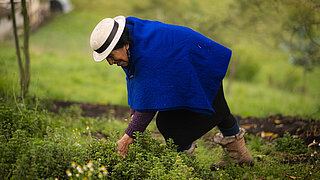
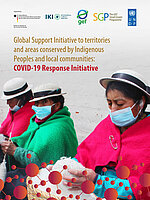
Since 2014, the IKI has been sponsoring the Global ICCA Support Initiative and is cooperating successfully with UNDP, the CBD Secretariat, the ICCA Consortium, the Small Grant Programme of the Global Environment Facility (GEF), the UNEP-WCMC, and the IUCN. Since then, IPLCs in 45 partner countries all over the world have received financial and technical support for 655 projects for the expansion of protected areas, the improvement of ecosystems, and for upholding and protecting traditional knowledge. In an additional financing phase, the initiative will be continued under the designation ICCA GSI 30x30 with another EUR 22 million in 50 countries as a contribution to the implementation of the global biodiversity targets.
Another example is the project “Transformative pathways: indigenous peoples and local communities leading and scaling up conservation and sustainable use of biodiversity” implemented by the Forest Peoples Programme (FPP). It supports local initiatives in five countries in self-determined land and resource management and in the development of local monitoring systems to demonstrate results and successes. In cooperation with national and regional governments and other key actors, the project is also working on the development of mechanisms for full and just participation in the national biodiversity policies and planning. In this way, the contributions of indigenous peoples and local communities are to achieve increased recognition, support, and expansion, also in the implementation of the GBF. One of the objectives of the project is to strengthen the rights of IPLCs.
In the project “Strengthening the blue economy of the Western Indian Ocean”, the Nature Conservancy and the project partner Northern Rangelands Trust are working in close cooperation with IPLCs in local coastal communities in Kenya to strengthen marine conservation and the sustainable utilisation of marine resources in the region. In the Lamu and Tana River regions, the project supports local communities in the reforestation and protection of mangrove forests. These coastal forests are major biodiversity hotspots and spawning areas for numerous fish species that are crucial to regional fisheries. In addition, the project supports IPLCs in the implementation of climate-resilient and sustainable fishing methods to safeguard fish stocks and, consequentially, local livelihoods in the long term.
The link has been copied to the clipboard
Contact
IKI Office
Zukunft – Umwelt – Gesellschaft (ZUG) gGmbH
Stresemannstraße 69-71
10963 Berlin





![[Translate to English:]](/fileadmin/_processed_/a/5/csm_20221215_CBDCOP15_2029ff5619.jpg)

![[Translate to English:] Walhai](/legacy/_processed_/d/4/csm_20210608_Walhai_Miguel_Schmitter_0106af1a48.jpg)
