

South Africa: A Sponge City in the Making
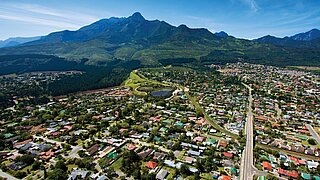
How George Municipality is rethinking water in the face of climate change – with support from the International Climate Initiative.
The climate is already shifting beneath George’s feet. Flooding events are growing more frequent and more intense. In 2021, 105mm of rain fell in just two hours, triggering flash floods that caused an estimated R750 million (about 39 million euros) in damage to municipal infrastructure alone. Four years on, the pendulum has swung: below-average rainfall has forced the city to impose water demand measures and raise tariffs, affecting every resident and business.
Water underpins everything George does. It sustains domestic use, commercial and industrial activity, tourism, and—critically—the municipality’s agro-ecosystems. Commercial agriculture is a primary sector, with high-value farmland dominating the local land use. Managing water more efficiently, including capturing and using stormwater, is essential to maintaining socio-economic resilience.
This is the tension George is determined to resolve. To accommodate economic growth without sacrificing its environment, biodiversity, or water security in the face of climate change, the city has set its sights on becoming a Sponge City—a vision that reframes stormwater not merely as a threat to be drained away, but as a critical resource to be managed holistically. Realising it will require stakeholders within and beyond the municipality to play their part in an ambitious transformation.
How the IKI supports the Journey from the Vision of a Sponge City to its Implementation
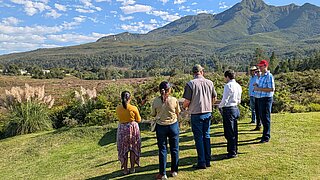
The project Low Carbon and Climate Resilient Water and Wastewater Management (LCCR Water), which is supported by Germany´s International Climate Initiative (IKI), is helping turn that ambition into action.
Developing Stormwater Management Guidelines
With the IKI project´s support, George has developed Stormwater Management Guidelines that embed Sponge City principles, like retaining and using rainwater on site and mimicking natural hydrology using permeable surfaces and green infrastructure, directly into planning and engineering processes across the entire municipality.
The guidelines offer practical examples for municipal staff and private developers alike, showing how to weave green infrastructure solutions for stormwater management into their designs. Supporting policies and by-laws will provide the regulatory clarity needed for consistent application.
Feasibility Study on the Implementation of the Principles of the Sponge City
The Camphersdrift River illustrates the challenge—and the opportunity: It carries a high flood risk to residential properties and municipal infrastructure. During the 2021 floods, the river was subject to significant erosion with substantial costs incurred for the rehabilitation of its riverbank. To mitigate against similar damage occurring in future, and demonstrate a case for ecological infrastructure, the city has identified a site upstream to pilot the Camphersdrift Flood Attenuation Park.
The initiative is set to become the city’s largest multi-purpose green infrastructure project to date. Commencing with a feasibility study financed by the IKI project, the park will serve as a pilot for testing how Sponge City principles can be implemented at scale and across departments.
Nature-based solutions like the park complement conventional grey infrastructure (including conventional engineered systems like concrete pipes, channels and retention tanks) within the broader stormwater management system. Beyond reducing flood risk, they deliver co-benefits that pipes and channels cannot: recreation space for surrounding communities, biodiversity conservation, and urban heat reduction.
By weaving together spatial planning, infrastructure investment, and environmental management, George is positioning itself as a leader among South Africa’s secondary cities:
“We are investing in a future that is safer, fairer, and more secure for everyone, exploring more sustainable ways to grow our city, manage water, and build resilience to climate change” says Delia Power, Deputy Director of Development and Environmental Planning at George Municipality.
Looking Ahead
The IKI project will also continue to contribute to this goal - through peer-learning with other cities in South Africa as well internationally, e.g. through a recent study visit to Hamburg, Germany, on how Hamburg is transitioning towards a Sponge City.
In addition, the project will assist George in identifying financing options for the implementation of the Sponge City transformation, e.g. through climate finance or payment for ecosystem-services.
Background Information
Challenges for South African Cities – the Case of George Municipality
George Municipality stands at a crossroads shared by cities across South Africa: how to advance economic development, protect ecosystems, and address persistent socio-economic inequality—all at once. These priorities sit at the heart of the country’s National Development Plan 2030, which calls for inclusive growth, sustainable resource management, and improved urban resilience.
On paper, these objectives reinforce one another. In practice, they pull in different directions. Economic growth drives land development and infrastructure demand, placing pressure on environmental systems—particularly water and biodiversity. Social equity demands that the city’s services, risk reduction, and opportunities reach all communities more fairly. And climate hazards hit hardest in vulnerable areas, deepening the very inequalities the city is working to close.
George’s natural setting is both its greatest asset and its most pressing constraint. A network of rivers, wetlands, forests, and ecological corridors threads through the city, flanked by the Outeniqua Mountains to the north and the Atlantic Ocean to the south. These systems perform critical functions: water provision, flood attenuation, and climate regulation.
About the Project
The project Low Carbon and Climate Resilient Water and Wastewater Management (LCCR Water) is funded by Germany’s International Climate Initiative and the Swiss State Secretariat for Economic Affairs (SECO).
The link has been copied to the clipboard
Contact
IKI Office
Zukunft – Umwelt – Gesellschaft (ZUG) gGmbH
Stresemannstraße 69-71
10963 Berlin
Key principles of a Sponge City
Retain and reuse — capture rainwater where it falls (infiltration, storage, wetlands) rather than rushing it off-site via hard drainage.
Mimic natural hydrology — restore pre-development water cycles through permeable surfaces, green infrastructure, and urban ecology rather than engineering around nature.