
Where New Perspectives Take Root
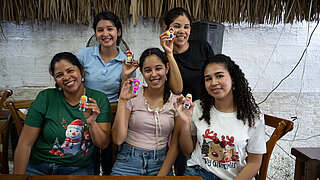
An IKI project is supporting Colombia’s coal-producing regions in their transition to economic models that combine agriculture and renewable energy.
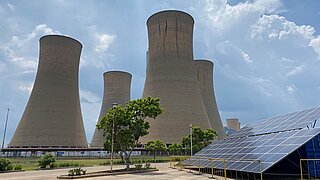
Dangerous coal dust remains part of everyday life in La Jagua de Ibirico, a small municipality in northern Colombia. For decades, coal mining for the international market has profoundly shaped many communities in the Cesar and Magdalena regions. It has brought health problems, land dispossession and water scarcity, as well as threats and violence against those who speak out about these issues.
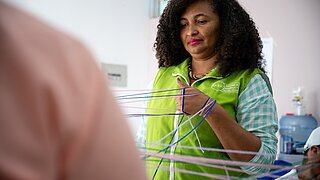
The project “Local Pathways to Phase Out Coal (CoL-JT)”, funded by the International Climate Initiative (IKI) through the IKI Medium Grants programme, is helping to address these challenges. Working directly with affected communities, it is creating new opportunities at the intersection of agriculture and renewable energy.
The end of a business model
Coal mining in Cesar and Magdalena is approaching its end. In 2021, the mining company Prodeco returned its mining licences to the Colombian state ahead of schedule, citing economic and technical reasons. Thousands of people lost their jobs virtually overnight.
In the coming years, the coal phase-out is expected to lead to further job losses in a region that continues to struggle with high levels of poverty despite decades of economic growth driven by the mining sector.
For many local residents, this is not the first major upheaval. Since the 1980s, communities have already experienced a transformation from traditional agriculture to coal extraction. The social, environmental and economic costs of that transition were immense, and the experience has left many people sceptical of yet another far-reaching change.
The scars of extractivism
To understand the urgency of a just transition in La Jagua de Ibirico and other places, it is not enough to look at the landscapes reshaped by open-pit mining. Above all, one must consider the social fabric of the community.
Coal exports have left behind fractured family structures, a loss of identity, and a range of other social consequences. For decades, the education system was geared towards meeting the needs of the mining industry. Young people in the region came to internalise the idea that education was worthwhile only if it served the coal sector. Critical thinking and occupational diversity were effectively buried beneath the dominance of coal.
Economic autonomy for women
These changes have had a particularly severe impact on women in the region. Before the mining boom, men and women largely shared responsibility for earning a living through fishing and agriculture. As these ecosystems disappeared, women’s opportunities were increasingly limited to precarious roles on the margins of the mining industry. The region became more male-dominated, while women’s economic autonomy was steadily eroded.
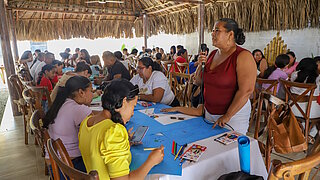
As part of the IKI project, the partners involved are therefore developing educational programmes focused on economic independence and renewable energy. These initiatives are designed to equip women with new skills and opportunities, enabling them to shape their own economic futures and expand their scope for action.
A new beginning on old roots
In their search for new opportunities, the people on the ground do not need to start from scratch. The department of Cesar has a long agricultural tradition, particularly in the cultivation of maize and cassava. This knowledge can be revived. Within the IKI project, researchers are therefore also examining how traditional farming practices can be combined with community-based energy use.
The aim is to develop a pilot agri-photovoltaic installation that combines solar energy production and agriculture on the same plot of land. The solar panels provide a reliable supply of electricity during the day. At the same time, their design creates partial shading at ground level, enabling crops to be grown that would otherwise be difficult to cultivate in the region’s heat. Where diesel generators once operated, the system reduces CO₂ emissions while strengthening local economic cycles and more democratic forms of energy production.
The approach is also intended to help reduce scepticism towards renewable energy. Public perception has been negatively affected by the construction of large solar parks implemented with limited involvement of nearby communities.
A vision for the region
The aim of the project “Local Pathways to Phase Out Coal (CoL-JT)” goes far beyond installing a functioning agri-photovoltaic system. The ongoing closure of mines makes it clear that even state institutions are only partially prepared for a comprehensive transformation.
In a series of workshops over the coming year, a shared vision for the region is to be developed together with academia, government, the private sector and local organisations. Only when all of these actors work in concert can the coal phase-out become what it should be: a historic opportunity to heal and to demonstrate that clean energy and social justice are two sides of the same coin.
About the IKI Medium Grants
With the IKI Medium Grants the German federal government supports projects for climate action and biodiversity conservation that particularly involve smaller civil society actors in developing and emerging countries. The IKI Medium Grants funding instruments is implemented by Zukunft – Umwelt – Gesellschaft (ZUG) gGmbH.
Together with the IKI Large Grants and IKI Small Grants, the IKI Medium Grants complete the competitive funding instrument form IKI Compete.
The link has been copied to the clipboard
Contact
IKI Office
Zukunft – Umwelt – Gesellschaft (ZUG) gGmbH
Stresemannstraße 69-71
10963 Berlin