
Safeguarding overlooked ecosystems: protect, manage and restore grasslands and savannahs in Argentina, Colombia and Paraguay
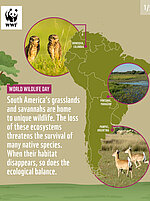
Grassland and savannah ecosystems in Argentina, Colombia and Paraguay harbour common social-cultural, economic and environmental values. They are home to unique biodiversity, ensuring water and food security, providing habitat for species, supporting livelihoods, and maintaining the cultural identity of rural and indigenous peoples. They also suffer from climate and land use change. Protected areas and low-impact cattle ranching practiced by local and indigenous communities can help safeguard these biomes. Through its 3 pillars “Protect, Manage, Restore” the project supports upscaling of existing sustainable management practices, creating resilient, connected and productive landscapes featuring sustainable food production with an aim to halt biodiversity loss and support climate change mitigation and adaptation. It will raise awareness of grasslands and savannahs on the global conservation and climate agendas, focusing on community research and south-south exchange.
- Countries
- Argentina, Colombia, Paraguay
- IKI funding
- 8,060,244.00 €
- Included preparation phase
- 261,378.00 €
- Duration
- 01/2024 till 12/2028
- Status
- open
- Implementing organisation
- World Wide Fund for Nature (WWF) - Germany
- Political Partner
-
- Ministry of Economy - Argentina
- Ministry of Environment and Sustainable Development (MinAmbiente) - Colombia
- Ministry of Agriculture and Rural Development - Colombia
- Ministry of Environment and Sustainable Development (MADES) - Paraguay
- Ministry of Agriculture and Livestock - Paraguay
- Undersecretariat of Environment and Sustainable Development - Argentina
- Implementing Partner
-
- Fundación Vida Silvestre Argentina - Argentinien
- World Wide Fund for Nature (WWF) - Colombia
- World Wide Fund for Nature (WWF) - Paraguay
- International Union for Conservation of Nature and Natural Resources (IUCN) - Switzerland
- Leibniz Centre for Agricultural Landscape Research (ZALF) e.V.
- global networks / agri benchmark
State of implementation/results
- The 5 years project on sustainable grasslands and savannahs was officially kicked-off by holding a workshop with all the project partners in Bogotá, Colombia, on 18-22 March 2024.
- Structures and framework conditions were set up in all countries and for all outputs of the project: I) Protect, II) Manage, III) Restore, IV) Policy and Communication, and V) Scientific Evidence and Knowledge through baseline analyses and stakeholder exchanges.
- In all countries, first areas have been identified for supporting the creation and effective management of new and existing protected and conserved areas (PCA) based on a due diligence analysis.
- In Argentina, a baseline of management effectiveness of two PAs to be supported by this project was performed and a Due Diligence for the creation of a private reserve is advanced. Partners are also in the process of discussing the due diligence analysis for the public PAs and supported farms.
- For Paraguay, three existing PAs have been selected and five new conservation units are being analysed to support their creation and/or national recognition.
- In Colombia, four farms were selected to be supported in the registration process to become a Natural reserve of civil society - RNSC (private and voluntary conservation), and technical support is provided. Progress was made in measuring management effectiveness (baseline) for three RNSC, one National Park (PNN El Tuparro) and one Integrated Management District (DNMI Cinaruco).
- The current conventional beef production systems were analysed in all countries (“business as usual” model), and workshops were conducted with community members, farmers and other local stakeholders to define sustainable management models and to update the project methodology of cost-benefit analysis.
- Consultations with four indigenous communities in the Paraguayan Pantanal were carried out based on the process of Free, Prior and Informed Consent (FPIC), another FPIC in the Humid Chaco community is ongoing. Based on the approval, work has begun to strengthen livelihoods and good management practices in the Pantanal area. An exchange of experiences and documentation on creole livestock in Paraguay has begun, including breeders, researchers, government, and international cooperation. Creole breeds are an example of livestock adapted to savanna and natural grassland ecosystems, representing a good management practice focused primarily on small producers.
- Similarly, methodological approaches and experiences on restoration have been assessed and first pilot areas have been selected to carry out restoration activities.
- In Argentina, restoration activities have begun in selected areas. In Paraguay, five sites have been selected for restoration in Humid Chaco and Pantanal. In Colombia, three methodological models have been proposed based on specific sub landscapes, and eight pilots were identified.
- The Global Grasslands and Savannahs Dialogue Platform launched a new website. Regular convenings are held every 4-6 weeks with experts from academia, NGOs, government and international organizations. Also, relevant information and publications linked to the project are disseminated via a new LinkedIn channel officially launched in October 2024, already counting more than 300 followers.-- In order to build alliances with other NGOs, governments and community representatives, one event was held at UNCBD COP16, and six events were held during UNCCD COP16 (e.g. a high-level event on funding grassland conservation), and a side event on the impacts of soil degradation on grasslands and savannahs (enb.iisd.org/…). Two policy briefs were presented, calling for integrated action under the Rio Conventions (wwfint.awsassets.panda.org/…) and showing a pathway to achieving Global Biodiversity Targets (iucn.org/…).
- UNCCD COP16 saw the first ever adoption of a decision on rangelands calling for prioritizing policies and investments for the sustainable management of rangelands and to support pastoralists and local communities.
- Two Colombian PhD students, one associated German PhD student, and three master students were selected so far for carrying out their research in the context of the project. The research focus areas and potential methods were collaboratively discussed and determined with the project partners and local institutions to ensure that the research will address pertinent local issues and contribute to institutional capacity building and knowledge interchange. The PhD research topics include the spatiotemporal analysis of socio-ecological networks, the relevance of private capital for conservation, and the integration of indigenous and local knowledge in fire management strategies. Field visits during 2024 and 2025 were realised in all three project countries to carry out research activities. Initial results were presented at international conferences and several scientific articles are currently under development.
Latest Update:
04/2026
Further links
- Global Grasslands and Savannahs Dialogue Platform
- Global Grasslands and Savannahs Dialogue Platform - LinkedIn channel
- UNCCD COP16: Adoption of a decision on rangelands
- Paraguay: Capturando al Cerrado Documentary YouTube Video
- Argentina: Las Pampas - Conservar y producir es posible You Tube Video
- Publication Poster: Socio-ecological network analysis for grasslands conservation management in Argentina, Colombia and Paraguay
- Scientific article: Mechanisms of Weak Governance in Grasslands and Wetlands of South America
- Protecting the Overlooked Carbon Sink: A policy Agenda for Grasslands
- Poster presented at Tropentag in Bonn (2025) and Living Data in Bogotá (2025): “The Role of Protected Areas in Conserving Lowland Grassland and Savannah Ecosystems in Latin America"
- Poster presented at Tropentag in Bonn (2025): “Historical Land Use Change and Statecraft in Grasslands and Savannas in South America: Shaping Agroecological Transitions”
Project relations
Legend:
The link has been copied to the clipboard

Related Publications
-
 11/ 2025 | Educational material
Grasslands and Savannahs: The Overlooked Climate Heroes
English (PDF, 2 MB)
-
-
10/ 2024 | Educational material
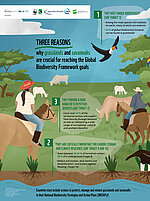
Three reasons why grasslands and savannahs are crucial for reaching the Global Biodiversity Framework goals
English (PDF, 11 MB)