Turning blue swimming crab waste into sustainable livelihoods
An IKI-funded project in the Philippines is investigating innovative ways of converting crustacean shells into high-quality biomaterials for various industrial sectors.
What if discarded crab shells could be transformed from environmental waste into a valuable, sustainable resource? For the residents of Igbon Island, this isn’t just a question – it is the blueprint for an alternative livelihood that could reshape their community’s future.
Igbon is a small island barangay in the municipality of Concepcion, located approximately 90 kilometers from Iloilo City center in the Philippines. Here, crab fishing is the lifeblood of the community. Local fishers harvest blue swimming crabs from the open sea and sell them to regional picking plants, where the meat is extracted primarily for export. Together, the island's four picking plants process up to 200 kilograms of crab meat daily – a figure that surges to 1,000 kilograms per day during peak seasons.
The ecological footprint of crab fishing
However, this thriving industry leaves behind a heavy ecological footprint. Once the meat is extracted, processing plants must rent land just to bury the empty shells. If left unmanaged, the decomposing waste emits a pungent odor and creates severe health hazards for nearby residents. Furthermore, the organic residue clinging to the discarded shells releases potent greenhouse gases as it rots, actively contributing to climate change.
For Ellene Basa, a lifelong resident of Igbon, crab fishing is more than just a job – it is a way of life. While her husband braves the open sea to harvest the catch, Ellene manages the operations on land. Yet, under the current economic model, their livelihood is precariously volatile. During the low fishing season, Ellene, her family, and the broader fishing community struggle to make ends meet. Currently, the extracted meat is the sole source of income for these fishers, leaving the hard upper shells – and their untapped economic value – completely ignored and discarded on land or at sea.

We learned that there are still ways to put crab shells to good use and prevent them from producing that unpleasant smell. It also gives us hope for alternative livelihoods, especially when the catch is low.
This is where the Crabsolutely Zero (CrabZero) project steps in. The initiative aims to revolutionize the local industry by turning what is left behind into sustainable solutions and a steady, secondary source of income.
A whole-of-society approach for Igbon
CrabZero explores innovative ways to convert blue swimming crab shells and other crustacean processing waste into high-value biomaterials for various industries. By coordinating the collection, sorting, cleaning, drying, and pre-processing of crab shell waste, the project is building a circular economy from the ground up.
By coordinating the collection, sorting, cleaning, drying, and pre-processing of crab shell waste, the project is building a circular economy from the ground up.
Beyond environmental remediation, the project empowers the residents of Igbon, transforming an ecological liability into a reliable pillar of financial resilience. Moreover, it will encourage investment and business opportunities by promoting the production of high-value biomaterials for potential international and European off-takers.
Giving crab shells a new purpose
To anchor this sustainable vision on the island, project partners collaborated to establish the Blue Swimming Crab (BSC) Shell Waste Pre-Processing Facility in Igbon.
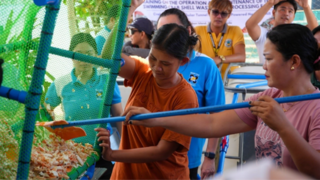
Designed to eliminate the shells' pungent odor, sanitize them through drying, and reduce their volume for efficient storage and transport, the facility is equipped with a specialized crab shell washer, a solar-powered grinder, and a solar dryer.
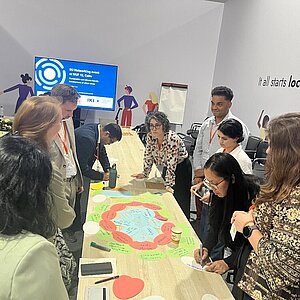
Crucially, the facility is managed directly by the members of BIGKAS, a community-based fisherfolk organization in Igbon. Local fishers worked hand-in-hand with the project partners to master the operations and maintenance of the equipment.
Through rigorous testing, they discovered that washing 15-kilogram batches of shells for approximately 20 minutes significantly neutralizes the foul smell while keeping fuel consumption to a minimum.
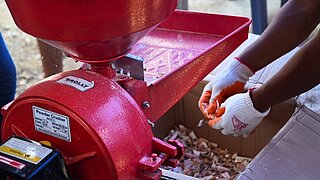
This precise process strips away the remaining organic tissue, effectively halting the decomposition that releases harmful climate-warming emissions. Furthermore, the solar dryers are versatile; during low-catch periods and non-peak seasons, the community can use them to process other food products, ensuring the facility remains an active, year-round asset.
Once crushed on the island, the pre-processed shells will be transported to the mainland. There, the first-ever chitosan extraction facility in the Philippines is scheduled for installation in the coming months. This pioneering plant will process the raw material into chitin and chitosan—high-value biomaterials widely sought after in pharmaceuticals, cosmetics, agriculture, water treatment, food preservation, textiles, and biotechnology.
By creating a localized supply chain, the initiative aims to prove both the technical feasibility and commercial viability of producing chitosan locally.
It also opens up extensive avenues for green investments in the Philippine crab sector, providing sustainable economic security for communities involved in everything from waste collection and pre-processing to transport and biochemical development.
New value for local waste
For Ellene and the members of BIGKAS, the most profound impact of this global partnership is felt right at home. What was once dismissed as a hazardous, foul-smelling pollutant is being reimagined as a reliable anchor for community livelihood.
Through CrabZero, a powerful circular economy is unfolding on the shores of Igbon. By unlocking the hidden value of crab shells, this small island is proving that environmental stewardship and economic resilience can go hand-in-hand, paving the way for a truly sustainable and inclusive future.
About the project
The CrabZero project is implemented under the broader framework of the European Union-Philippines Green Economy Partnership Launched under its Global Gateway initiative, this European strategy engages with partners worldwide to promote smart, clean, and secure investments centered around shared priorities like the transition to a circular economy. This specific component of the programme is co-funded by a 12 million EUR grant from the EU and a 1 million EUR contribution from Germany’s International Climate Initiative.
The link has been copied to the clipboard
Contact
IKI Office
Zukunft – Umwelt – Gesellschaft (ZUG) gGmbH
Stresemannstraße 69-71
10963 Berlin