Colombia is one of the most biodiverse countries in the world: around ten percent of all species found globally are present there. Protecting these species and their habitats is therefore of significant international interest. The country is marked by social unrest and armed conflicts. The security situation, especially for human rights and environmental activists, as well as indigenous populations, is particularly challenging in rural areas.
Colombia plans to submit its second Nationally Determined Contribution (NDC) for the period up to 2035 at COP30 in November 2025. The "NDC 3.0" will be developed in line with the country's long-term climate strategy and is expected to strengthen the adaptation component and improve the information and implementation of the measures used for the national mitigation target. The first updated NDC from 2020 included a significant increase in the level of ambition compared to the original NDC from 2015 by raising the reduction target from 20 to 51 per cent. Reducing emissions from deforestation is a key component of Colombia's mitigation measures. To fully decarbonise its economy, further efforts are needed in the energy and transportation sectors, according to the Climate Action Tracker.
At the 26th Conference of the Parties (COP 26) to the UN Framework Convention on Climate Change (UNFCCC) held in Glasgow in 2021, Colombia also unveiled its Long-Term Low Greenhouse Gas Emission Development Strategy (LTS), the so called "E2025". The overarching goal is to achieve climate neutrality by 2050, with a focus on sectors responsible for the highest greenhouse gas emissions – energy, agriculture, forestry, and other land uses (AFOLU). Colombia’s government intends a government-wide coordination through the LTS for a low-carbon and resilient development of the country. The 2050 carbon neutrality target was also enshrined in Colombia’s domestic law in 2021.
Back in 2016, the country initiated its process to develop a National Adaptation Plan (NAP), which was led by the National Planning Department (DNP) and submitted in 2021.
In 2012, Colombia published its National Biodiversity Policy, followed in 2017 by its National Biodiversity Strategy and Action Plan (NBSAP) (2016-2030), within the framework of the Convention on Biological Diversity (CBD), aimed at implementing strategic biodiversity targets. In 2024, the country published its updated NBSAP at the CBD COP16 in Cali - the Biodiversity Action Plan (BAP) 2024 - 2030. It defines four national priority areas with six goals for the implementation of the Global Biodiversity Framework (GBF). Until the next CBD COP in Armenia in 2026, Colombia will hold the COP presidency and is particularly responsible for supporting the CBD.
Colombia was also a founding member of the NDC Partnership in 2016 and has since received support for various requests, including from IKI projects directly.
The cooperation with Colombia is particularly strong in the IKI funding areas of Mitigating Greenhouse Gas Emissions and Conserving Biological Diversity. In the area of mitigation, cooperation is primarily covered by several multi-country projects and represents the largest funding area. Main topics are
NDC and LTS support,
Just Energy Transition (JET), including coal phase-out and energy communities,
Sustainably Energy and Resilience,
Green Financing, and
Sustainable Urban Development and Low-carbon Mobility.
In the funding area of Conserving Biological Diversity (Biodiversity and Marine Protection) the main topics are
Management of Protected Areas and Peace,
Ecosystem protection and restoration and the sustainable use of ecosystem-based services,
Cross-border measures to protect marine megafauna,
Nature-based Solutions, NbS,
NBSAPs and biodiversity monitoring approaches,
Support for Indigenous Peoples and Community Conserved Areas and Territories (ICCAs), and
Biodiversity Financing.
The other IKI funding areas are a little less represented.
In the funding area of Adapting to the Impacts of Climate Change, the most important topics are
NAPs and NDC,
Ecosystem-based Adaptation (EbA),
Nature-based Solutions (NbS) for resilient, low-carbon and biodiverse developments, as well as
Land Use and Agriculture.
In the funding area of Preserving and Restoring Natural Carbon Sinks, the focus is on
Forest Landscape Restoration (FLR),
Protection and conservation of moors and wetlands,
deforestation-free and sustainable supply and value chains.
Strengthening bilateral cooperation Through the IKI Country Call Colombia
Colombia was one of the first three countries with which the IKI prepared and implemented country calls in 2017/18.
The second Country Call Colombia was implemented in 2024 and projects on two key topics were selected:
Roll-out of renewable energies and economic diversification for a just coal phase-out (BMWE)
Landscape scale restoration as an economic and multifunctional nature-based solution for peace (BMUKN)
Partnership for Climate and a Just Energy Transition
In June 2023, Colombia and Germany signed an Alliance for the Climate and a Just Energy Transition (KEP) and launched it in October 2023. From the German side, along with the IKI ministries (Federal Ministry for Economic Affairs and Energy (BMWE), Federal Ministry for the Environment, Climate Action, Nature Conservation and Nuclear Safety (BMUKN), and Federal Foreign Office (AA)), the Federal Ministry for Economic Cooperation and Development (BMZ) is also a partner. The first high-level CEP dialogue between Colombia and Germany took place in Bogotá in June 2025.
The key topics of the Partnership for Climate and a Just Energy Transition are:
Just energy transition: Expansion of renewable energies, green hydrogen, coal phase-out, energy communities
Climate action: strategic dialogues in the context of international negotiations, support for COP30, strengthening capacities in international negotiations, support for the training of female leaders
Protection and sustainable use of biodiversity and the environment: support for COP17, synergies between biodiversity and climate, bioeconomy
Sustainable and resilient urban development: strengthening decentralised cooperation in the field of sustainable urban development, energy transition in the transport sector, strengthening the gender approach in the field of sustainable urban development, Conversápolis platform
Climate and biodiversity finance: access to finance for climate action and biodiversity, promoting exchange on green taxonomy, strengthening capacities for green finance, event on climate finance 2025
Interface project
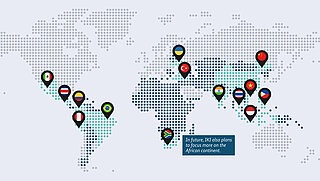
All priority countries of the IKI also engage in so-called IKI interface projects, which have permanent project offices in the capital city of the respective country. Alongside their own, country-specific project commission, these interface projects are also tasked with maintaining close contact to environment and climate ministries as well as networking with other relevant ministries in the field of climate and biodiversity policy. Beyond this, the interface projects also work to network all of the IKI projects in the country and region together so as to promote synergies.
Strengthening mechanisms for climate protection and a just energy transition.
Promoting low-carbon and climate-resilient measures in the industry and mining-energy sectors.
Strengthening conditions for achieving Colombia's biodiversity goals in line with the new Global Biodiversity Framework (GBF).
Supporting political dialogue between Colombia and Germany on climate change, just energy transition, and biodiversity, and facilitating knowledge exchange and networking of IKI projects in the country and region.
Supporting the Climate Secretariat in the operational design and implementation of the climate partnership.
Ministry of Environment and Sustainable Development
Ministry of Agriculture and Rural Development
Ministry of Mining and Energy
Ministry of Transport
Ministry of Housing, City and Territory
National Planning Department
Ministry of Finance and Public Credit
Ministry of Foreign Affairs
IKI Strategy
The IKI wants to maximise its impact on climate action and biodiversity conservation. To this end, it concentrates its funding activities on prioritised fields of action within the four funding areas. Another key element is the close cooperation with selected partner countries, especially with the IKI’s priority countries.