

Developing sustainable and climate-friendly urban and peri-urban areas
Overarching priority area of the International Climate Initiative (Last updated: January 2025)
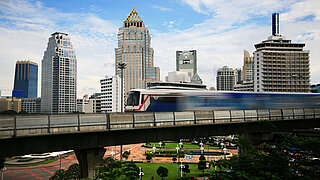
Today, more than half of all people live in cities; by 2050, this figure is set to rise to two out of three. This continuing surge in urbanisation will mainly take place in conurbations in emerging economies and developing countries. Existing medium-sized and large cities will grow and new ones will emerge.
In the future, it will be necessary to choose climate-friendly and sustainable development paths for these growing areas. After all, urban and peri-urban areas are hotbeds of traffic-related, waste management and building-related (cooling, heating, building materials) emissions. According to the German Advisory Council on Global Change (WBGU), for example, cities are responsible for around 70 per cent of global energy use and global energy-related CO2 emissions.
Cities are also under great pressure to adapt to the impacts of climate change, for example they are called upon to deal with heat island effects, water scarcity, rising sea levels or floods and storms. At the same time, they are suffering from a loss of natural ecosystems and their services, partly due to the high level of soil sealing.
This is precisely why IKI funding in this overarching priority area has a particular potential for impact. Lock-in effects can be avoided through forward-looking urban, infrastructure and land planning. As cities are both living and economic spaces, reliable infrastructure also provides an important basis for ensuring good conditions for jobs and sustainable production areas.
In urban areas, innovative, nature-based solutions can also create biodiversity-promoting habitats with high climate relevance. Furthermore, neighbourhood-based approaches with inclusive participation processes can produce local solutions with a high level of ownership (for example through neighbourhood initiatives), resulting in a sustainable, climate-friendly transformation of urban space.
Increasing importance of climate-neutral and resilient cities
The key role of cities as actors in climate protection was formally recognised for the first time in 2015 during the climate negotiations at COP21 in Paris. At the third UN summit on housing and sustainable urban development – the Habitat III conference in Quito in October 2016 – global objectives and guidelines for sustainable urban development were also enshrined in the “New Urban Agenda”.
The 2030 Agenda also emphasises the important contribution that cities make to achieving the Sustainable Development Goals through SDG 11 (“Sustainable cities and communities”). The Kunming-Montreal Global Biodiversity Framework, which was adopted at the 15th COP of the Convention on Biological Diversity (CBD) in 2022, also includes the enhancement of green spaces and urban planning for human well-being and biodiversity (Target 12).
The latest report from the Intergovernmental Panel on Climate Change (IPCC) not only shows the increasing importance of cities as a human habitat, but also the extent to which they are affected by advancing climate change. At the same time, the report makes it clear that cities play a key role in the achievement of national and international climate action and biodiversity conservation goals. The report by the UN Environment Programme (together with the International Resource Panel) underlines that urbanisation is not just a challenge, but can also be an opportunity for global sustainability.
These examples show not only the increasing anchoring of sustainable urban development in international agreements and recommendations for action, but also the growing importance of the urban perspective for sustainable development and climate protection.
IKI approaches to sustainable urban development
The importance of cities for climate change mitigation is also reflected in the funding focus of the International Climate Initiative (IKI). The topic of “sustainable urban development” has been a cross-sectoral funding priority since 2015 and part of the IKI strategy since 2023. IKI projects support partner countries and cities in developing strategies for sustainable, climate-friendly and resilient urban development and urban biodiversity. The focus is on integrative and sustainable approaches to the development of urban and peri-urban areas. Capacity building concerns both local and higher levels and takes the form of knowledge transfer, technological cooperation, policy advice and investment in pilot projects, among other things.
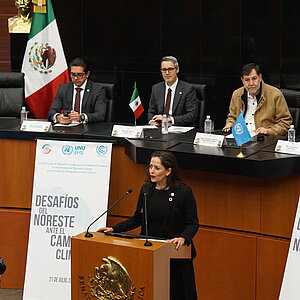
Urban climate action projects focus on the development of local climate action plans, the vertical and horizontal integration of climate action strategies and policies, and financing mechanisms for climate action activities. In Mexico, Argentina and Brazil, for example, the IKI supports urban coalitions, known as Urban Labs, in which local actors such as city dwellers, NGOs, the private sector and other urban stakeholders work together. A bottom-up approach is used to develop and discuss strategies relating to urban development that contribute to greenhouse gas mitigation and climate change adaptation while simultaneously reducing social inequality.
In the area of adaptation to climate change, the focus is on strengthening urban resilience. The aim is to better prepare cities and disadvantaged neighbourhoods for the challenges of climate change and to reduce risks to people, the environment and livelihoods. In Thailand, for example, a project is working on building up urban resilience. Nature-based solutions (NbS) are being identified on the basis of climate risk models, integrated into urban development plans and implemented on a pilot basis.
The urban biodiversity measures focus on integrating ecosystem services into urban development and promoting ecosystem-based adaptation measures. In San Jose, Costa Rica, for example, the creation of biological corridors is also helping to restore the water supply, regulate the microclimate and create recreational areas. This not only promotes the preservation of biodiversity, but also improves the well-being of the urban population in the metropolitan region.
How cities and municipalities can finance their remodelling
Worldwide, over 65 trillion US dollars will have to be invested in the construction of sustainable infrastructure in cities by 2030. This corresponds to 70 per cent of the required investment in sustainable infrastructure worldwide. The challenges that cities and municipalities face when developing and implementing climate action projects are manifold.
They range from increasing debt and budgetary constraints to inadequate credit ratings. In addition to financial bottlenecks, local authorities often do not have sufficient planning, design and preparation capacities to develop corresponding projects. For this reason, the IKI is supporting the City Climate Finance Gap Fund – with the involvement of the European Investment Bank (EIB) and the World Bank – which closes this gap. The Gap Fund directly supports cities in low- and middle-income countries that have already made commitments in line with the Paris Agreement at an early stage of project preparation.
In many cases, financial resources are also lacking for local and participatory approaches to climate action and resilience. Mexico is therefore promoting the trialling of an approach for the co-design, scaling and replication of integrative climate protection measures at neighbourhood level.
Selected projects
- URBAN: Urban Resilience Building and Nature: Innovating Urban Planning for Resiliency with Nature-based Solutions and Climate Risk Models in Thailand
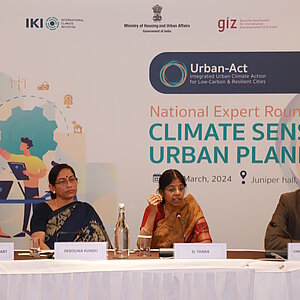
- Urban-Act: Integrated Urban Climate Action for low-carbon & resilient cities
- Transformative Urban Coalitions: Catalysing urban partnerships to drive systemic transformation towards sustainability
- EcoZones: Piloting an approach for co-designing, scaling and replicating inclusive climate action at the neighbourhood level
- City Climate Finance Gap Fund II - EIB
- City Climate Finance Gap Fund I - World Bank
- Biodiver_CITY – Establishment of Interurban Corridors
- Support for the Brazilian National Agenda for Sustainable Urban Development (ANDUS)
- Cities Matter: Capacity building in sub-Saharan African megacities for transformational climate change mitigation
- INTERACT-Bio Integrated regional action for Biodiversity
The IKI Strategy
The IKI wants to maximise its impact on climate action and biodiversity conservation. To this end, it concentrates its funding activities on prioritised fields of action within the four funding areas and on three cross-cutting priorities. Another key element is the close cooperation with selected partner countries, especially with the IKI’s priority countries.
City Climate Finance Gap Fund
The City Climate Finance Gap Fund is the first global fund dedicated to support cities in the very early stages of project development. This will be key to the realisation of countries’ NDCs.
World Bank Blog "Sustainable cities"
10 Years of sustainable urban development in the International Climate Initiative
#IKISustainableCities #ResilientUrbanFuture
In 2025, the International Climate Initiative looks back on 10 years of “sustainable urban development”: This topic has been an overarching focus within IKI’s funding areas since 2015. Globally, well over 100 IKI projects on sustainable urban development have been implemented in more than 50 countries to date. Here you will find the latest insights into our project work:









The link has been copied to the clipboard