
Building collaborations for Forest Landscape Restoration
![[Translate to English:] Sechs Beteilgte des Projektes RECAP4NDC stehen am Rande eines Feldes in Alwar, Rajasthan, und lassen sich von Landwirten die Landnutzung beschreiben.](/fileadmin/_processed_/7/7/csm_20260526_22_III_123_RECAP4NDC_a6ab401855.jpeg)
In India, the IKI is helping to establish a private-sector partnership that will restore 20,000 hectares of land and support 10,000 farmers.
India’s ambitious targets for Forest Landscape Restoration (FLR) demand long-term financing for planning, implementation, monitoring and value chain development. With an increasing focus on net zero and Corporate Social Responsibility mandates, the private sector is interested and well placed to contribute and make restoration efforts more durable.
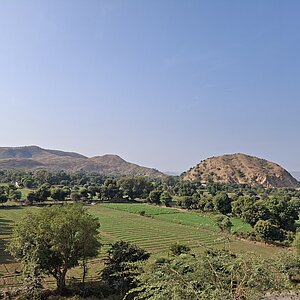
The IKI project “Restore, Conserve and Protect Forest and Tree Cover for NDC Implementation in India” (RECAP4NDC) is an example how this can work. It has initiated a three-year partnership on FLR with the Lupin Human Welfare & Research Foundation (LHWRF). Together they aim to advance sustainable agriculture and agroforestry practices across 20,000 hectares in the districts Alwar and Dhule – improving livelihoods and benefiting 10,000 smallholder and marginal farmers in the region.
Landscape selection and building a partnership
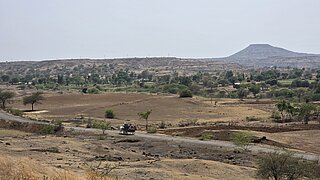
Alwar and Dhule have unique landscapes with a forest-grassland-agriculture land use continuum. LHWRF has historically worked in these districts by implementing various watershed and sustainable agriculture activities. ”In landscapes such as Alwar and Dhule, FLR represents a strategic convergence of ecological stewardship and livelihood enhancement, enabling us to deliver long-term, climate-resilient impact at scale", says Tushara Shankar, Head of Corporate Social Responsibility at LHWRF, about the project.
As a part of the landscape selection process for FLR in and around Alwar and Dhule, the IKI project conducted a geospatial analysis using Geographic Information Systems. This was coupled with ground verification and application of a multi parameter assessment matrix. On that basis, suitable degraded areas wherein FLR would be implemented were selected. These were then proposed to the LHWRF for collaboration by bringing the broader landscape into focus.
"Our collaboration with the International Climate Initiative reflects a shared commitment to advancing large-scale, science-based restoration anchored in strong community institutions”, says Yogesh Raut, Head Livelihoods Programme at LHWRF, about the cooperation.
Promoting Sustainable Agriculture and Agroforestry
The partnership will set up demonstration plots in the region integrating tree and crop-based agriculture. Dairy-based livelihood measures will be enhanced by securing access to fodder resources. In addition to this, tree-based products from the plots and Non-Timber Forest Produce from nearby forest areas will be linked to markets via LHWRF’s existing network of Self-Help Groups and Farmer Producer Organisations.
The partnership will also work on water conservation measures in upstream forests, leveraging RECAP4NDC’s cooperation with the State Forest Departments. They are the main implementation partners at the state-level that oversee project activities via a formally established Executive Committee, chaired by Head of State Forest Force.
Benefits to Local Communities
The restoration plans that encapsulate the activities of the partnership are designed to consider landscape characteristics, climate change impacts and livelihood priorities. The partnership intends to improve the resilience of beneficiary community members by providing diversified income streams and reducing sensitivity to extreme climate events.
Part of the goal of the project is to enable stakeholders at the local level (e.g., farmers and their families) to derive ecological, socio-economic, governance and climate change benefits from FLR. Their participation is crucial to implement and scale activities along with that of the Farmer Products Organisations and Self-Help Groups.
Other partnerships and a way forward
As part of its activities, RECAP4NDC is also exploring the development of carbon projects in different forms. Together with Value Networks Ventures, a carbon project developer, the RECAP4NDC-LHWRF partnership is trying to design voluntary carbon projects. The sale of carbon credits from such projects will add another meaningful income stream for farmers.
These partnerships demonstrate how landscape restoration planning can be implemented on the ground. The IKI project, acting as a connector, brings together private sector actors as well as state actors from various government departments to pursue shared objectives.
These solutions do not necessarily require complex decision-making mechanisms; they simply require a mutual recognition of the interdependencies among different actions in the landscape and an understanding of how actors can collaborate. This way, they can achieve lasting change, improve ecological, social and economic conditions, and enhance climate resilience for both people and ecosystems. Support from the IKI helped establish these important private sector partnerships in India and will continue to do so.
The link has been copied to the clipboard
Contact
IKI Office
Zukunft – Umwelt – Gesellschaft (ZUG) gGmbH
Stresemannstraße 69-71
10963 Berlin