
Cool Up programme demonstrates that sustainable cooling works in real-world conditions
Rising temperatures and urban growth are rapidly increasing the demand for cooling across the Middle East and North Africa. Conventional air conditioning and refrigeration systems often rely on energy-intensive technologies and climate-damaging refrigerants. The Cool Up programme, funded by the IKI, shows that a different path is possible.
Jordan’s first CO₂ cold rooms

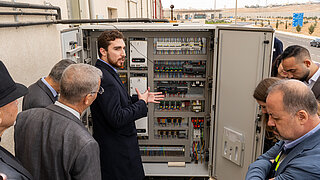
The first walk-in CO₂ (R744) cold rooms in the country have been installed at the Jordanian Customs Department in Amman as part of Cool Up’s demonstration projects. Designed by local company Abdin Industrial, the system provides 40 kW of cooling capacity to a 280 m² medium-temperature and a 140 m² low-temperature room. CO₂ has a global warming potential of 1 and offers high efficiency in commercial refrigeration applications.
The installation supports food safety while demonstrating that natural refrigerants can be safely applied in the MENA climate. Continuous monitoring provides evidence on reliability, operating costs and adequate efficiency, with initial results indicating that the system is operating as intended despite the harsh climatic conditions, with an average coefficient of performance (COP) of 3 of the total system. This in turn helps local banks, retailers, and logistics companies to assess the potential for replication. This installation is expected to save around 85 tCO2e by the end of its lifetime.
Propane cooling for the Aqaba Marine Reserve

A second milestone was achieved at the Aqaba Marine Reserve Visitor Centre, where Cool Up supported the installation of a 30 kW air-conditioning system using propane (R290) as a natural refrigerant with an ultra-low global warming potential of 3. The unit, developed by the Jordanian manufacturer Petra Engineering, replaces a 22-year-old R22 chiller and is designed to operate reliably at temperatures above 46°C.
While the energy savings of the retrofit are moderate due to the existing water-loop infrastructure, the climate benefit is substantial: the switch from f-gases to R290 dramatically reduces direct emissions with up to 22 tCO2e over the lifetime of the unit. The site now functions as a “living lab”, demonstrating high efficiency (COP >4) under harsh climate conditions, generating operational data and training opportunities for technicians and facility managers. The model is highly relevant for hotels, public buildings, and tourism facilities across the region.
Measurable climate relevance

Jordan’s cooling challenge is immense: the number of air-conditioning units is projected to rise from 1 million in 2020 to 4.5 million by 2050. Without action, emissions from cooling would soar. Cool Up studies show that widespread deployment of efficient, natural-refrigerant technologies could avoid up to 72% of AC-related emissions and 76% of commercial refrigeration emissions by mid-century. Demonstration projects are a practical first step towards this transformation.
Beyond individual sites, the demonstrations are influencing standards, procurement decisions, and financial incentives. They show businesses and public authorities that climate-friendly cooling is a market-ready reality. By de-risking investments and building local expertise, Cool Up accelerates the shift towards energy-efficiency, resilient food chains, and lower greenhouse-gas emissions.
The two demonstration projects in Jordan show how targeted IKI support can turn global climate commitments into tangible results—cutting emissions, building local capacity, and enabling markets for sustainable cooling. By operating in the real world, they lay the groundwork for scalable, long-term transformation in the cooling sector.
Making an impact

The progress made in Jordan reflects the catalytic role of the IKI in enabling projects that translate climate ambition into tangible change on the ground. The project works with policy, industry, and technical partners to connect policy development with practical implementation. By testing technologies in real-world conditions and strengthening local capacities, the programme helps create regulatory confidence, market readiness, and technical expertise needed to scale up sustainable cooling beyond pilot sites.
Cool Up’s demonstration projects help bridge policy frameworks and implementation by testing solutions under everyday conditions and generating evidence for decision-makers. This comes at a pivotal moment, as Jordan has published its first National Cooling Action Plan (NCAP), which outlines a path to meet rising cooling demand while reducing emissions and strengthening resilience—an effort developed in close collaboration between the Ministry of Environment and Cool Up. The NCAP aligns with and supports Jordan’s climate commitments and contributes to strengthening the national climate policy implementation.
The link has been copied to the clipboard
Contact
IKI Office
Zukunft – Umwelt – Gesellschaft (ZUG) gGmbH
Stresemannstraße 69-71
10963 Berlin