
Funding the conservation of mangrove forests with CO₂ credits
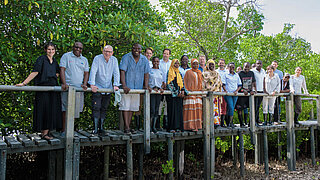
A blue carbon project in Gazi Bay on Kenya's coast demonstrates how climate action, biodiversity conservation and sustainable development can go hand in hand.

On the margins of the eleventh Our Ocean Conference, a high-level delegation from Germany's Federal Ministry for the Environment, Climate Action, Nature Conservation and Nuclear Safety (BMUKN) visited the project Transboundary Conservation and Sustainable Management of Marine and Coastal Ecosystems, which is funded by Germany’s International Climate Initiative (IKI).
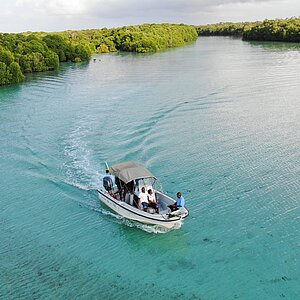
The delegation, led by State Secretary Jochen Flasbarth, took a boat into the mangrove channels of Gazi Bay, home to Mikoko Pamoja, the world's first project to fund mangrove conservation through the sale of carbon credits. Now in its second decade, Mikoko Pamoja protects 117 hectares of mangrove forest within a wider 615-hectare system, work that has so far saved or sequestered more than 22,000 tonnes of CO₂.
An estimated 80 per cent of fish stocks along the coast rely on mangroves at some point in their life cycle, whether for breeding, shelter, or food. The mangroves are also among the most carbon-dense ecosystems on the planet, storing up to four times more carbon than other tropical forests, while their dense root systems form a natural buffer against coastal erosion and storm surges.
A double benefit: how nature conservation improves community life

The visit also explained how the model turns climate action and biodiversity conservation into community benefit:
Credits sold to international buyers are held in trust by the Association for Coastal Ecosystem Services (ACES) and released to the Mikoko Pamoja Community Organisation once conservation targets are met.
Residents then decide how to spend the funds, more than USD 190,000 to date, through open village meetings, often on clean water, health, school renovation and education.
Listening to young local leaders
After the boat trip, the delegation sat down with representatives of four Beach Management Units (BMUs) from the wider Shimoni-Vanga area.
The discussion covered both the everyday challenges of managing local fisheries and marine resources and the difference the project's support -training in leadership, financial management, monitoring and conflict resolution, among other areas - has made on the ground.

As a young woman, I used to be too shy to speak to people. Today, I confidently collect data from fishermen and present my findings to leaders of Beach Management Units and the assembly. This work has given me confidence.
The discussion reinforced a core principle of the IKI project: Lasting coastal conservation can only succeed if it is not imposed from the outside. Instead, it must be rooted in the local communities that depend on these resources and built around their existing governance and organisational structures.
The vision is a shared reserve across the border
The final part of the visit turned to the project's longer-term ambition. Kenya and Tanzania committed to a Transboundary Conservation Area in 2015, and the IKI project is now proposing a Biosphere Reserve under UNESCO's Man and the Biosphere Programme as the vehicle to help deliver it.
Under this approach, each country first establishes its own national Biosphere Reserve, then the two are connected through a joint management framework.
Communities are an integral part of this process from the start, helping define the reserve's zones and taking part in its management once established, which is one of the main reasons the project chose MAB as the framework.
Tanzania's dossier is now in its final stages, while Kenya's has recently begun, laying the groundwork for what would become one of the region's first marine transboundary biosphere reserves.
A model worth scaling
For the delegation, which was in Kenya to discuss ocean protection in a global context, the visit to Gazi offered a first-hand look at what effective marine conservation can achieve when it is driven by the people who live alongside and depend on these ecosystems every day.
It is a model that the IKI Kwale-Tanga project is now working to extend along the wider Kwale-Tanga coastline and across the border into Tanzania.
The link has been copied to the clipboard
Contact
IKI Office
Zukunft – Umwelt – Gesellschaft (ZUG) gGmbH
Stresemannstraße 69-71
10963 Berlin
What does blue carbon mean?
Some marine ecosystems help to remove CO₂ from the water column and store it over the long term. This is referred to as ‘blue carbon’ and ‘blue carbon ecosystems’. (Source: Federal Agency for Nature Conservation)
![[Translate to English:] Cover "Collaborative Fisheries Management Area Governance Assessment for Tanga (Tanzania)"](/fileadmin/_processed_/1/0/csm_20260107_Governance_Assessment_Report-_Tanga_Cover_8c407a1789.jpg)