

Transforming Climate Action Through Digital Participation in Indian Cities
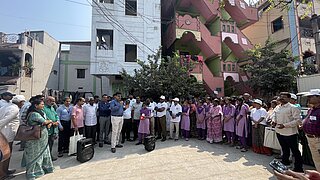
The International Climate Initiative shows in the city of Visakhapatnam, that the most powerful solutions to climate threats emerge when people and technology work together.
As global temperatures in 2024 surpassed 1.5°C above pre‑industrial levels for the first time, cities are emerging at the frontline of both climate risks and innovations.
Against this urgent backdrop, the project “Transformative Climate Action using Participatory Data-Driven Decision-Making Platform”s (T-CAP) in the Indian city of Visakhapatnam has developed an innovative, locally actionable framework for participatory climate action. T-CAP demonstrates how digitalisation, citizen participation and climate action can converge to drive systemic change in urban India. The project is funded through the Medium Grants programme of the International Climate Initiative (IKI).
This novel framework, bringing together digitalization, climate action and participation, was operationalized in practice through the establishment of an Urban Living Lab (ULL) in Visakhapatnam. This ULL was named as V-PULL (“Visakhapatnam Prajamukhi Urban Living Lab") by the citizens.
Through piloting of the urban flooding use case, the ULL demonstrated how cities can co-create climate solutions with communities. Built within Visakhapatnam’s municipal governance structure, the ULL leverages digital tools, grassroots participation, and institutional collaboration to generate inclusive, real‑time, and context‑sensitive climate responses. The initiative was jointly implemented by a consortium of non-profit and governmental organisations in partnership with the Greater Visakhapatnam Municipal Corporation (GVMC) alongside community groups, academic institutions, volunteers, private sector innovators, and ward‑level governance units under the Sachivalayam (a volunteer-based neighbourhood level municipal outreach initiative) system.
The project team used the insights gained from the pilot in Visakhapatnam to bring results to many other places in India. Subsequently, a national‑scale uptake involving 12 Indian cities through workshops, surveys, and digital campaigns shared the project learnings from cities across the country.
Bridging the gap between community needs, dynamic data, and institutional responses
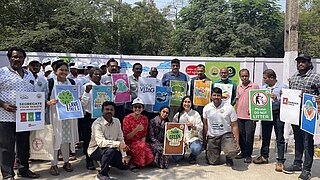
With rapid urbanisation and escalating climate hazards such as heatwaves and floods, medium‑sized cities such as Visakhapatnam are confronting sharp climate vulnerabilities that are often felt most acutely by women, workers in the informal sector, persons with disabilities, and residents of informal settlements. Traditional top‑down governance models have struggled to bridge the gap between community needs, dynamic data, and institutional responses. T‑CAP offers a proof of concept for a new pathway: one where communities co‑create climate decisions, technology strengthens trust, robustness, and transparency, and the government embraces iterative, citizen‑centred solutions.
Towards this goal, the ULL established for piloting T-CAP’s novel participatory climate action framework (V‑PULL) institutionalised a seven‑stage participatory cycle, enabling citizens to identify problems, co‑design interventions, and validate solutions. Through ward‑level meetings held in the local language, workshops with highly vulnerable women groups, volunteer trainings, and academic partnerships, T-CAP embedded local ownership.
Digital tools driving climate action
T-CAP co-created several digital solutions:
- Flood hazard mapping integrating 20+ geospatial indicators
- Community demarcated afforestation zones to reduce runoff through Nature‑based solutions
- V‑PULL mobile app, allowing ward staff to record impacts and infrastructure vulnerabilities through on community feedback
- The V‑PULL website, providing live dashboards, knowledge products, and transparent channels for citizen–government interaction
Gaining national momentum
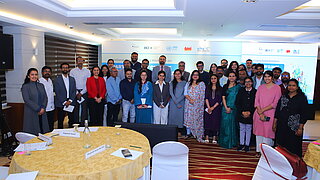
A national workshop, a digital campaign, a survey with more than 800 respondents across 50 cities, and a National Roundtable expanded the model. Findings informed a National Advisory, three training manuals, and a massive open online course (MOOC) enabling other cities to replicate or adapt the approach. The experience shows that:
- Community‑driven, digitally enabled climate action strengthens resilience, particularly for vulnerable populations.
- Locally led innovation leads to contextually appropriate, socially embedded solutions that are more sustainable over time.
- Digital transparency builds trust, accelerates preventive actions, and enhances adaptive capacity
In essence, the project demonstrates that the future of climate governance lies in participatory digital ecosystems, not in isolated technologies or top‑down policies. It stands as a scalable model for the Global South cities aspiring to become just, resilient, and people‑centred in the era of accelerating climate change.
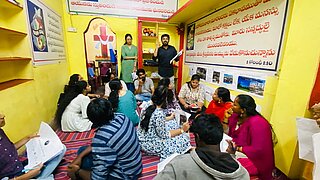
Widespread attention and recognition for the project
Towards the end of the project, GVMC advanced the V‑PULL approach by piloting additional use cases. GVMC submitted V‑PULL as a demonstrated model of transforming urban climate action in the Global South to the Bloomberg Foundation’s Global Mayors Challenge 2026. V‑PULL was declared among the 24 global winners (out of 630 participating cities) in February 2026, bringing global recognition and financial resources.
With this, the T‑CAP impact story continues in Visakhapatnam, transforming climate action through participation, digitalisation, and inspiring cities across the globe.
About the IKI Medium Grants
With the IKI Medium Grants the German federal government supports projects for climate action and biodiversity conservation that particularly involve smaller civil society actors in developing and emerging countries. The IKI Medium Grants funding instruments is implemented by Zukunft – Umwelt – Gesellschaft (ZUG) gGmbH.
Together with the IKI Large Grants and IKI Small Grants, the IKI Medium Grants complete the competitive funding instrument form IKI Compete.
The link has been copied to the clipboard
Contact
IKI Office
Zukunft – Umwelt – Gesellschaft (ZUG) gGmbH
Stresemannstraße 69-71
10963 Berlin