
Policy Advice for Climate Resilient Economic Development
In many countries, there is a lack of expertise in the model-based assessment of country-specific climate change impacts on economic development. The quantification of the economic effects can support knowledge-based policy decisions, which are necessary for climate-resilient economic policies, investments in future-proof sectors, and effective adaptation planning. Therefore, the project worked with local stakeholders to implement methods and instruments for the calculation of the economic impacts of climate change impacts and their benefits for policy-making. Then, the project made piloted methods and instruments available to governments and development organisations. The project promoted international exchange by networking with thematic platforms, providing studies, and making available the lessons learned during the project in a structured form to encourage the replication of the project activities.
- Countries
- Georgia, Kazakhstan, Viet Nam
- IKI funding
- 6,000,000.00 €
- Duration
- 01/2019 till 06/2025
- Status
- completed
- Implementing organisation
- Deutsche Gesellschaft für Internationale Zusammenarbeit (GIZ) GmbH
- Political Partner
-
- Ministry of Economy and Sustainable Development (MoESD), Georgia
- Ministry of National Economy – Kazakhstan
- Ministry of Planning and Investment - Viet Nam
- Implementing Partner
-
- Central Institute for Economic Management (CIEM)
- Institute of Economic Research
- Ministry of Economy and Sustainable Development (MoESD), Georgia
State of implementation/results
- Project completed.
- Together with partners countries, the Climate Resilient Economic Development (CRED) project has developed national macroeconomic models that calculate the country-specific consequences of climate change and appropriate adaptation measures on gross domestic product and employment. Thus, the models show that investments in adaptation measures are effective and profitable.
- In Georgia and Kazakhstan, dynamic input-output models (e3.ge, e3.kz) were developed with experts from the Gesellschaft für Wirtschaftliche Strukturforschung (GWS), and in Viet Nam, a general dynamic equilibrium model (DGE-CRED) was developed with the Institut für Wirtschaftsforschung Halle (IWH). In the countries, 10-30 economists participated in the trainings, partly as model developers or model users.
- Since 2021, the trained economists have been supported with coaching in the calculation of several adaptation scenarios for selected sectors (agriculture, tourism/infrastructure in Georgia; agriculture, energy and infrastructure in Kazakhstan; agriculture, forestry and housing in Viet Nam) and data updating.
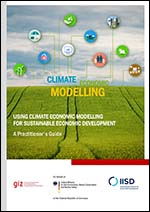
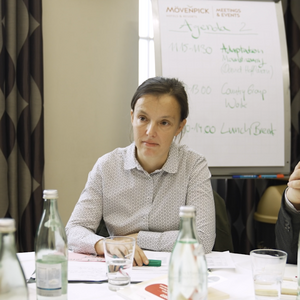
- A prototype macroeconomic model was developed based on country-specific data from international databases. This prototype model was adapted for Mongolia as an example. The prototype enables the provision of short training courses for other interested countries. A three-day training was held in Mongolia in December 2022, followed by virtual short trainings for over 100 interested experts from different countries.
- Analyses and infographics of model results are available, as are detailed national reports describing modeling experiences and results. A global report elaborates on project experiences across countries (www.international-climate-initiative.com/…).
- Inter-ministerial workshops in the pilot countries were held in late 2022 / early 2023 to discuss future application of the models for national adaptation planning.
- In 2024, the project organized two interministerial workshops in Kazakhstan: the NDC Partnership Scoping Mission and the conference to develop the draft roadmap for the implementation of the strategy to achieve carbon neutrality in Kazakhstan by 2060.
- Since mid-2024, the CRED project has been working intensively on developing policy scenarios and recommendations for action to support the political processes in Georgia and Kazakhstan. Selected scenarios are being quantified through cost-benefit analyses and macroeconomic modeling. Project Idea Notes are also being prepared for both countries. These build on the policy scenarios and describe financing options for implementing the recommendations for action.
- At the end of 2024, the CRED project completed a climate risks database and analysis of the main climate risks for Georgia, Kazakhstan, and Mongolia and made it available to the partners.
- The CRED project and its partners regularly contribute their experiences at relevant events, including the Seventh Meeting of the Katowice Committee on the Impacts of the Implementation of Response Measures (KCI) in Sharm El-Sheik, November 2-3, 2022 (unfccc-events.azureedge.net/…), an event with d/carb on macroeconomic modelling (www.decarb.world/…) and on 24 September 2024 at Climate Week NYC.
- The CRED project's approach to using macroeconomic models for national adaptation planning is explained in a video: www.international-climate-initiative.com/…
- The project publishes regularly in blogs: most recently on Promoting Climate Adaptation through International Cooperation (www.international-climate-initiative.com/…).
- A scientific publication was published by the project partners Open Acces in the Low Carbon Economy Journal. Title: "Evidence-Based Support for Adaptation Policies in Emerging Economies" (www.scirp.org/…).
Latest Update:
04/2026
Further links
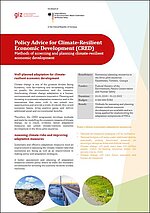
- CRED Factsheet
- Article: Evidence-Based Support for Adaptation Policies in Emerging Economies
- Report: Resilient Economic Growth Through Sectoral Adaptation Actions In Georgia
- Project Brief
- Infographic: Impacts of Climate Change and Adaptation in Agriculture in Georgia
- Infographic: Impacts of Climate Change and Adaptation in Agriculture in Kazakhstan
- Infographic: Impacts of Climate Change and Adaptation in the Energy Sector in Kazakhstan
- Infographic: Impacts of Climate Change and Adaptation in Tourism and Infrastructure in Georgia
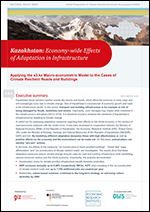
- Infographic: Impacts of Climate Change and Adaptation in Infrastructure in Kazakhstan
- Infographic: Policy Advice for Climate Resilient Economic Development (CRED)
Project relations
Legend:
The link has been copied to the clipboard
Related Videos



Related Publications
-
 01/ 2024 | Publication types | Report
CRED Factsheet: Methods for Assessing and Planning Climate-Resilient Economic Development (2024)
English (PDF, 763 KB)
-
03/ 2023 | Educational material
Strengthening Decision-Making for Risk-Informed Development
English (PDF, 581 KB)
-
-
05/ 2022 | Educational material
Macroeconomic Modelling for Climate Policy Planning
English (PDF, 521 KB)
-
-
-





![[Translate to English:] Cover Toward Climate Resilient Economic Development in Kazakhstan](/fileadmin/_processed_/0/9/csm_20220119_toward-climate-resilient-economic-development-in-Kazakhstan_Cover_0f9d205ac4.jpg)