
Cooperation between the IKI and its partner countries
Last updated: February 2026
With the International Climate Initiative (IKI), the German government promotes projects with maximum impact for climate action and biodiversity conservation, in particular through ideas competitions. To this end, it has developed the IKI Strategy 2023, which sets clear geographical and thematic priorities: The IKI concentrates its funding primarily on its priority countries and strategic fields of action.
Global justice in joint crisis management
The idea behind this is that the global community can only overcome the climate and biodiversity crisis if all countries pull together – and make their own contribution depending on their respective situation. In the spirit of global justice, the industrialised countries have a particular responsibility in this regard because, while developing countries have contributed little to global warming to date, they are particularly badly affected by the consequences.
At the same time, emissions are rising rapidly, particularly in emerging economies. The IKI therefore supports emerging economies and developing countries in those areas where it can have the greatest possible impact with the available resources.
IKI Strategy 2030
Further Links
The geographical focus of the IKI
Selection of partner countries
In principle, all recipient countries of official development assistance (ODA) from the Organisation for Economic Co-operation and Development (OECD) are eligible for selection as IKI partner countries.
Under the Strategy of the International Climate Initiative up to 2030, the funding programme focuses its cooperation on specific priority countries, which have been selected on the basis of the following criteria:
- high and/or rapidly increasing greenhouse gas emissions;
- great importance for global biodiversity conservation;
- regional pioneers characterised by a strong political commitment to climate and biodiversity protection.
The IKI priority countries
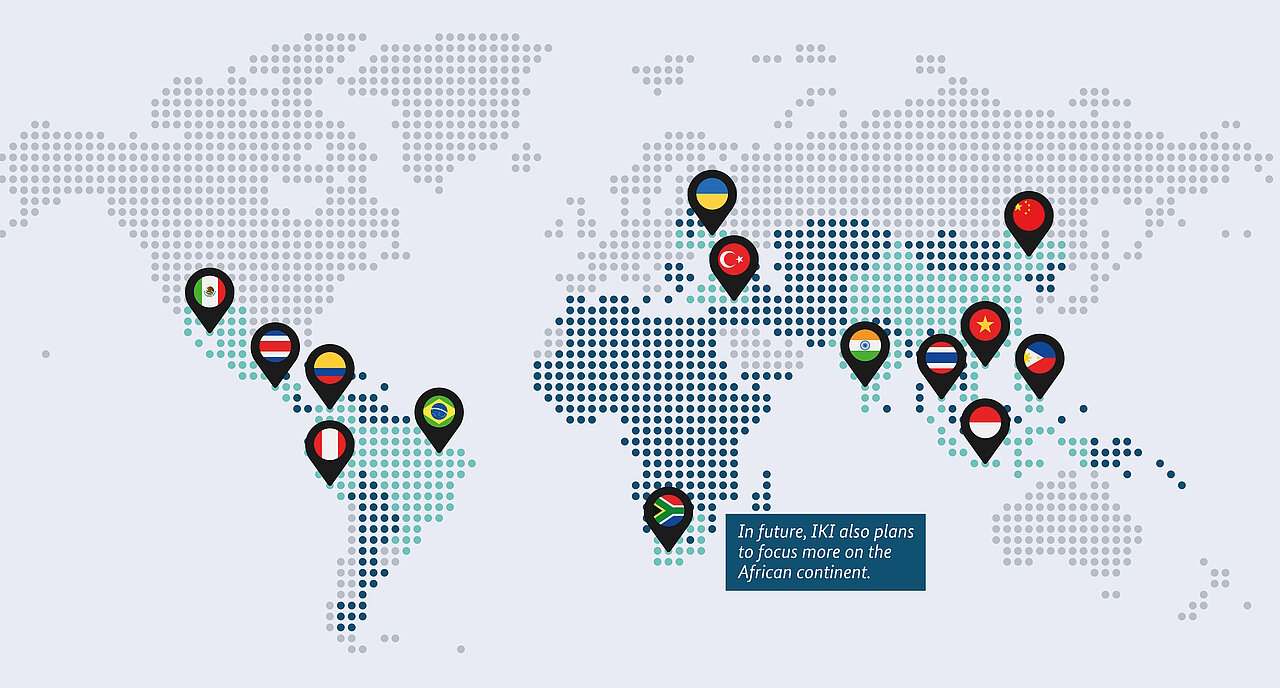
The IKI priority countries include Brazil, China, Colombia, Costa Rica, India, Indonesia, Mexico, Peru, the Philippines, South Africa, Thailand, Türkiye, Ukraine and Viet Nam.
Together, these 14 countries already account for almost 50 percent of global greenhouse gas emissions and around 80 percent of emissions from developing and emerging countries. The IKI priority countries are also home to 25 of the global biodiversity hotspots, where an exceptionally high concentration of endemic species is affected by significant habitat loss. Climate change is further intensifying this effect. These hotspots contain the remaining habitats of 44 percent of all plant species and 35 percent of all vertebrate species worldwide.
The IKI aims to concentrate around 80 percent of funding commitments for bilateral projects on its priority countries by 2030. This means that work with these 14 partner countries will be gradually intensified.
The selection of priority countries will be adjusted on the basis of the above criteria if conditions change. This applies in particular to the IKI’s involvement in Africa. Despite the continent’s great importance for global climate and biodiversity protection, only one African country, South Africa, is currently defined as an IKI priority country.
Interface projects for political and professional networking in the region
The priority countries feature IKI interface projects that operate offices in the capital cities. In addition to their own country-specific project mandate, the tasks of the interface projects include
- working in close cooperation with the ministries responsible for climate, energy and biodiversity and the German embassies on the ground, and
- networking all IKI projects in the country and thus promoting synergies for project work.
The priority countries in the IKI calls
IKI Large Grants
Since 2025, the IKI has been addressing current challenges in climate action, climate change adaptation and biodiversity conservation through its annual IKI Large Grants.
The thematic and country priorities of the IKI Large Grants calls are guided by the outcomes of international negotiations conducted in the context of the United Nations Framework Convention on Climate Change (UNFCCC) and the Convention on Biological Diversity (CBD).
The country priorities are closely coordinated with the partner ministries of the relevant IKI partner countries. The evaluation and selection of proposals for country priorities also takes place in close consultation with the partner ministries.
Full details on the IKI Large Grants
2017 to 2024: IKI Country Calls
From 2017 to 2024, the IKI – in collaboration with partner governments – launched country-specific, bilateral funding calls (known as ‘country calls’) in most of its priority countries. The aim of these country calls was to focus on one or two climate or biodiversity topics that had been closely agreed with the respective partner government.
Further information on the completed country calls can be found here.
IKI interface projects
- Climate Policy Programme Brazil (PoMuC)
- Sino-German Cooperation on Climate Change – NDC Implementation
- ACCION Clima III - NDC implementation Costa Rica and regional knowledge exchange
- Indo-German Support project for Climate Action in India
- Climate and Biodiversity Hub Indonesia
- Supporting Colombia in implementing its climate, energy and biodiversity goals
- Mexican-German Climate Change Alliance – Phase IV
- NDC Peru: support to the implementation of the National Climate Change Strategy
- Transformative Actions for Climate and Ecological Protection and Development (TRANSCEND)
- Climate Support Programme IV
- Climate, Coastal and Marine Biodiversity in Thailand (CCMB Thailand)
- Supporting the national energy efficiency fund and the climate-friendly reform agenda (S2I) in Ukraine
- Support to Viet Nam for the Implementation of the Paris Agreement II
IKI´s priority countries
Brazil

Colombia
Mexico
South Africa

Ukraine


India
Peru

Thailand

Viet Nam
Costa Rica

Indonesia
Philippines


The link has been copied to the clipboard