Transformative städtische Koalitionen: Städtepartnerschaften zur Förderung der systemischen Transformation in Richtung Nachhaltigkeit katalysieren
Städte sind für 75 Prozent der Kohlenstoffemissionen verantwortlich und entscheidend, um globale Emissionsziele zu erreichen. Eine schnelle und radikale Dekarbonisierung, die über rein technische Lösungen hinausgehen, erfordert ganzheitliche Ansätze und die Unterstützung verschiedener Akteure. Um diese Prozesse im stark urbanisierten Lateinamerika auszulösen, implementiert das Projekt Pilotprojekte in fünf urbanen Laboren (Urban Labs) in Mexiko, Brasilien und Argentinien und testet neue Modelle der Zusammenarbeit und Entscheidungsfindung . Sie werden durch transformative Forschung, Kommunikationsstrategien und Aktivitäten zum Aufbau von Ressourcen und Kompetenzen verstärkt. Das Projekt nutzt Film und Kunst, um neue Narrative einer attraktiven urbanen Zukunft und eine veränderte Denkweise hin zu mehr Nachhaltigkeit anzustoßen. Modelle der Zusammenarbeit und Entscheidungsfindung werden ausgeweitet und wirken auf die nationalen und globalen Agenden für Nachhaltigkeitstransformationen ein.
- Länder
- Argentinien, Brasilien, Mexiko
- IKI Förderung
- 11.688.305,00 €
- Darin enthaltene Vorbereitungsphase
- 402.509,31 €
- Laufzeit
- 01/2021 bis 12/2026
- Status
- laufend
- Durchführungs -organisation
- United Nations University Institute for Environment and Human Security (UNU-EHS)
- Politischer Partner
-
- Ministry for Agricultural, Territorial and Urban Development (SEDATU) - Mexico
- Ministry of Cities (MCidades) - Brazil
- Ministry of Health and Social Development - Argentina
- Ministry of Integration and Regional Development (MIDR) - Brazil
- Undersecretariat of Environment and Sustainable Development - Argentina
- Durchführungspartner
-
- German Institute of Development and Sustainability (IDOS)
- International Institute for Environment and Development (IIED)
- World Resources Institute (WRI)
- Online
Stand der Umsetzung/Ergebnisse
- Project website in English, Portuguese and Spanish with multiple project publications: www.urbancoalitions.org
- Urban Labs operating in Argentina (Buenos Aires), Brazil (Recife, Teresina) and Mexico (Léon, Naucalpan), involving a diverse range of stakeholders who collaborate and exchange knowledge to co-create innovative solutions for complex urban challenges in a way that is participatory, cross-sectoral and inclusive.
- Ongoing design and implementation of local demonstration activities by Urban Labs:
- Argentina:
- Buenos Aires: Supporting a participatory upgrading process of a slum neighbourhood, Villa 20, with new ideas, connecting decarbonisation with improving urban equality and climate justice.
- Brazil:
- Recife: Working on integrated solutions, projects and transformations to address challenges of the Pilar Community, an area in the city’s historic core called Bairro do Recife where 350 families face spatial, territorial and socioeconomic challenges.
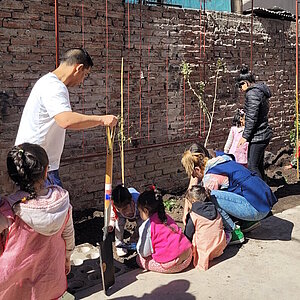
- Teresina: Implementing sustainable initiatives and creating multipurpose community spaces and gardens in Residencial Edgar Gayoso, a housing complex with high socioeconomic vulnerability where more than 450 families are forced to travel long distances to the city centre and lack access to qualified amenities, services and nearby urban spaces.
- Mexico:
- Léon: Promoting a vision of low motorised transport, blue-green infrastructure in public spaces, energy-efficient buildings and a circular, local economy, benefiting residents and generating a sense of community and identity.
- Naucalpan: Transforming the industrial area surrounding the polluted Hondo River through an urban regeneration project that addresses both climate change and inequality concerning neighbouring residents.
- Argentina:
- Community of Transformation meetings to exchange of knowledge and experience among Urban Labs and interested actors.
- Co-developed Capacity development courses on technical and soft skills for transformative change delivered to 2.249 local, national and international city-makers.
- Continous transformative research by ethnographic observation, surveys and interviews to assess changes in networks, mindsets, capacities and governance in Urban Labs, yielding insights into challenges and opportunities towards urban sustainability transformation and climate action.
- Local and global transformative communication approaches are implemented, including by video competition and the 4th photo exhibition at UNFCCC COP30.
- As part of the effort to inspire and create narratives of urban futures the ‘A True Paradise’ film series, directed by Oscar Award-winning directors Dirk Wilutzky and Mathilde Bonnefoy, published and screened 15 short films with global and local thought leaders.
- Scaling of TUC approach, including by scaling Villa20 Urban Lab approach to Rosario in Argentina, by feeding TUC lessons learned into Brazil's Periferia Viva Programme, and by publishing learnings across Urban Labs, inclduing the "Weaving Urban Futures" toolbox launched at COP30.
Letzte Aktualisierung:
04/2026
Weiterführende Links
- Bericht: Transformative Urban Coalitions: Phase I Global Visioning Report 2022
- City Profile: Naucalpan/Mexico (EN)
- City Profile: León/Mexico (EN)
- City Profile: Teresina/Brazil (EN)
- Fotowettbewerb 2023
- City Profile: Buenos Aires/Argentina (EN)
- City Profile: Recife/Brazil (EN)
- Arikel: Exploring the links between the use of NbS, mindshifts and transformative urban coalitions to promote climate resilience within an ongoing reurbanization process. The case of Villa 20. Front. Sustain. Cities. 4 (EN)
- Interview: Integrating climate action into neighbourhood upgrading in Villa 20, Buenos Aires (EN)
- Artikel: Inclusive planning processes to accelerate climate-just transformations (EN)
- Wissenschaftlicher Artikel: Identifying mindsets for urban sustainability transformation: insights from Urban Labs (EN)
- Wissenschaftlicher Artikel: Urban labs beyond Europe: the formation and contextualization of experimental climate governance in five Latin American cities (EN)
- Studie: Decarbonising Cities: Assessing Governance Approaches for Transformative Change (EN)
Relationen zum Projekt
Legende:
Der Link wurde in die Zwischenablage kopiert